 Malunggay Compass
Prices and costs below are illustrative planning figures compiled from published ranges, market listings, and industry reporting. They are not quotations. Verify current farmgate, wholesale, and input prices in your locality before committing capital — and read the disclaimer.
1. The price landscape
| Product | Typical price band (PHP) | Notes |
|---|---|---|
| Fresh leaves, retail (public market) | ₱20–50 / kg (often sold per bundle: ₱5–15 per tali) | Davao market reporting shows bundles as low as ₱10 for three stems; Metro Manila retail per-kilo prices run higher |
| Fresh leaves, farmgate | ₱10–25 / kg | Highly negotiable; contract supply to processors sits in the upper half |
| Dried leaf powder, wholesale | ₱300–800 / kg | Depends on quality (color, mesh, moisture), volume, and organic status |
| Dried leaf powder, retail packaged | ₱150–300 / 100 g | Lazada/Shopee listings commonly ~₱145 per 50 g pack for branded organic powder |
| Tea bags / blended tea | ₱80–250 / box | Entry product for many rural processors |
| Moringa oil (ben oil) | ₱2,000–6,000+ / L (small batches) | Cosmetic-grade niche; yields per hectare are low, so price must be high |
| Seeds (for sowing) | ₱1–10 / seed; ₱500–3,000 / kg | Niche but real demand from new planters |
| Seedlings / cuttings | ₱10–50 / piece | Nursery income stream while the main block matures |
One kilo of fresh leaves might be ₱15 at farmgate. Dry that kilo (4–5 kg fresh → 1 kg dry), mill and pack it, and the same farm output can be worth ₱300–800 per kilo of powder wholesale. Processing — not planting — is where the margin lives. But processing requires capital, skills, and compliance (see Processing & Products).
2. Market channels
🥬 Wet markets & palengke traders
Buys: fresh leaves, tender pods.
Pros: daily demand, no standards paperwork.
Cons: lowest prices, price haggling, spoilage risk, no volume commitment.
🏭 Food processors & powder brands
Buys: fresh leaves by contract (they dry/mill), or your powder.
Pros: volume, stable specs, repeat orders.
Cons: quality/traceability requirements; often want organic or GAP.
🏛️ Institutional buyers
Buys: fresh or dried for feeding programs, canteens, LGU nutrition projects.
Pros: steady, mission-aligned demand.
Cons: government payment cycles; documentation.
🧴 Cosmetics & herbal manufacturers
Buys: powder, oil, seed cake.
Pros: premium prices for certified material.
Cons: small volumes, strict QC, certifications (organic, ISO) expected.
🌐 Direct retail (online & farm store)
Buys: your branded packs, tea, capsules.
Pros: best margins per kilo; brand equity.
Cons: you carry marketing, FDA registration, and inventory costs.
🚢 Exporters
Buys: bulk powder/oil meeting import-country specs.
Pros: large volumes; foreign exchange.
Cons: the highest bar: organic certification, lab tests (heavy metals, micro), phytosanitary paperwork.
3. Sample budget — ½ hectare fresh-leaf farm
A conservative, manual-operations model: perennial hedge at 1 m × 1 m (≈ 5,000 hills per ½ ha after losses), first cut at month 3–4, then every ~70 days. Yards of fresh leaf per hectare vary hugely; we model 12 t/ha in year 1 (partial year) and 20 t/ha steady-state — deliberately modest against literature highs.
| Item | Year 1 (PHP) | Year 2 (PHP) | Notes |
|---|---|---|---|
| Land prep (plowing, harrowing, layout) | 12,000 | — | Carabao/tractor hire |
| Planting materials (seed + gaps) | 4,000 | — | ~5,500 seeds/seedlings |
| Compost/manure (basal + topdress) | 15,000 | 10,000 | 5–8 t/ha equivalent |
| Fertilizer (split NPK program) | 12,000 | 18,000 | Soil-test based |
| Weeding & maintenance labor | 18,000 | 15,000 | Family + hired |
| Irrigation (surface pump share + fuel) | 8,000 | 10,000 | Dry-season watering |
| Harvest labor (cutting, stripping, bagging) | 10,000 | 20,000 | ≈ ₱1/kg at volume |
| Containers, sacks, misc. | 4,000 | 6,000 | — |
| Total cash costs | ≈ ₱83,000 | ≈ ₱79,000 | Excludes land rent & owner labor |
| Production (fresh leaf) | 6,000 kg | 10,000 kg | ½ ha basis |
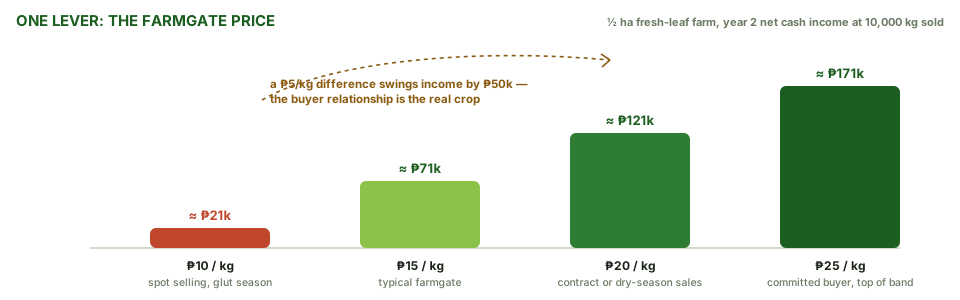
| Gross income @ ₱15/kg farmgate | ₱90,000 | ₱150,000 | Price is the swing variable |
| Net cash income | ≈ ₱7,000 | ≈ ₱71,000 | Year 1 ≈ break-even is normal |
At ₱15/kg, year-2 net is ≈ ₱71k. At ₱20/kg it is ≈ ₱121k; at ₱10/kg it is ≈ ₱21k. A fresh-leaf farm lives and dies on its buyer relationship — which is why contract growing (fixed price, committed volume) transforms the model.
4. Sample budget — 1 ha powder-supply farm (with on-farm drying)
Same agronomy, but the farmer dries and mills, selling powder to a processor or brand at wholesale. Assumes 1 m × 0.75 m hedge (≈ 13,000 hills), steady-state 24 t/ha fresh, 4.5:1 fresh-to-dry ratio (≈ 5.3 t dry powder potential; we model 4 t sold after losses), basic solar-assisted dryer and a comminuting mill.
| Item | Steady-state year (PHP) | Notes |
|---|---|---|
| Crop production costs (as above, 1 ha) | 160,000 | Full fertilizer + harvest labor |
| Drying, milling, packing labor & consumables | 90,000 | Strip → wash → dry → mill → sieve → pack |
| Packaging (food-grade bags, labels) | 40,000 | Bulk packs for processor |
| Utilities, testing (moisture, micro per contract) | 35,000 | Lab tests per buyer requirement |
| Equipment depreciation (dryer, mill) | 30,000 | ~₱300k CAPEX over ~10 yrs |
| Total costs | ≈ ₱355,000 | — |
| Sale: 4,000 kg powder @ ₱450/kg wholesale | ₱1,800,000 | Quality & contract dependent |
| Net income | ≈ ₱1,445,000 | Before financing & certification costs |
5. Value-added math at a glance
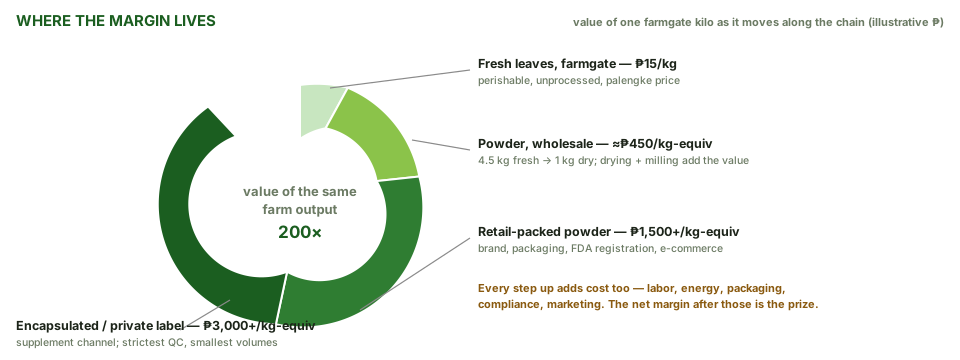
Example: powder = (₱450 ÷ ₱15) × (1 ÷ 4.5) ≈ 6.7× gross value per kg fresh
Each step up the chain adds cost too: labor, energy, packaging, compliance, marketing, and risk. The net margin after those is the real prize — typically still multiples of fresh-leaf farming, but earned with more work and capital.
6. Finding buyers
Map your local demand first
Market vendors, restaurants, canteens, hotels with healthy menus, feeding programs, and nearby malunggay-product brands. A single regular bulk buyer beats five occasional ones.
Approach processors with volume commitments
Powder brands and tea manufacturers publish contact details; industry groups (see Industry & Policy) can introduce growers. Bring samples, moisture data, and a price schedule.
Join a growers' association or cluster
Aggregation solves smallholder problems: shared dryers, shared labs, collective hauling, and negotiating power. Many DA and LGU programs fund clusters, not individuals.
Use DA/LGU trading platforms
Regional agri offices, Kadiwa events, and e-commerce onboarding programs connect farms to buyers at low cost.
Put your farm on the record
Register with the Municipal Agriculture Office and get into DA's farmer registry — it is the gateway to programs, planting materials, and buyer referrals.
7. Cost-plus pricing, worked example
When you sell powder — whether to a brand or under your own — you need a floor price. Build it from real costs, then decide the margin; don't start from the market's price and hope costs fit.
| Step | Basis (1 ha intensive example) | ₱ / kg powder |
|---|---|---|
| 1. Growing cost | ₱160,000 ÷ 45,000 kg fresh = ₱3.6/kg fresh | 16.1 |
| 2. × conversion ratio (4.5 kg fresh → 1 kg dry) | ₱3.6 × 4.5 | — |
| growing cost per kg powder | 16.1 | |
| 3. Processing cost (labor, energy, packing) | ₱130,000 ÷ 10,000 kg powder | 13.0 |
| 4. Overhead + testing (share of utilities, lab, admin) | ₱75,000 ÷ 10,000 kg | 7.5 |
| 5. Loss allowance (rejections, fines, shrinkage ~8%) | (steps 2–4) × 0.08 | 2.9 |
| Full cost per kg powder | ≈ ₱39.5 | |
| 6. Target margin (60% on cost) | ₱39.5 × 0.60 | 23.7 |
| Floor wholesale price | ≈ ₱63/kg |
Two realities to reconcile with this floor: market wholesale bands run ₱300–800/kg for quality powder (see the price landscape), and the model above deliberately excludes land rent, owner salary, and certification. So the floor tells you the danger line — any offer below it loses money — while the market band tells you what's achievable with quality and relationship. Price between floor and band, based on your certification, consistency, and volume.
target price = floor × (1 + target margin)
8. Financing the build-out
Moving from fresh-leaf selling to processing takes capital — dryers, mills, packing, working capital. Typical funding paths for Philippine smallholders and SSEs:
| Source | Typical form | Good fit | Watch-outs |
|---|---|---|---|
| DA programs (HVCDP, machinery pools) | Grant-in-kind: planting materials, dryers/mills to clusters & co-ops | Organized associations with track records | Group-based; apply via MAO; waiting lists |
| DAAC / ACPC credit | Agri micro-finance loans at concessional rates | Registered farm enterprises with simple books | Requires registry listing & repayment discipline |
| LandBank / DBP agri loans | Production & equipment term loans | Larger expansions, incorporated co-ops | Collateral & documentation requirements |
| DTI livelihood programs / NEGOSYO centers | Business dev support, some equipment grants, training | Value-adding SSEs (tea, baked goods) | Batch windows; comply with registration first |
| LGU livelihood funds | Small grants, shared postharvest facilities | Barangay-level clusters | Politically cyclical; formalize requests |
| Buyer/contract financing | Input advances or equipment against supply contracts | Farms with committed quality buyers | Tie pricing honestly; avoid debt-locking output below cost |
Most successful moringa SSEs finance in stages: grant-supported dryer → cash-flow the mill from tea/powder sales → loan the packaging line only after a named buyer is signed. Don't borrow against hoped-for demand; borrow against contracts.
9. Risks and how to manage them
| Risk | Reality | Mitigation |
|---|---|---|
| Price crash / oversupply | Fresh leaf is perishable and substitutable; local gluts happen | Contract growing; diversify products (powder/tea); stagger plantings |
| Quality rejection | Powder buyers test moisture, color, micro; rejections are total losses | Invest in proper drying (see drying guide); keep records; test before shipping |
| Typhoon damage | Brittle wood breaks; defoliation in storms | Low hedges, windbreaks, insurance (PCIC), fast resprouting is your friend |
| Dry-season yield dip | Unirrigated blocks stall in the dry months | Water storage + drip; schedule cuts around water availability |
| Pest outbreaks | Webber caterpillars can strip flush quickly | Weekly monitoring; Bt; prune out webs (see IPM) |
| Cash-flow gap in year 1 | First harvests are small; costs are front-loaded | Intercrop rows (pechay, kamote) early; sell seedlings; phase the planting |
The processing steps that create the margin: Processing & Products. The industry context behind prices: Industry & Policy.