 Malunggay Compass
- Climate requirements
- Soil requirements & site selection
- Land preparation
- Propagation & planting out
- Spacing systems
- Fertilization & soil health
- Water management
- Weeds, mulch, intercropping & agroforestry
- Pruning & canopy management
- Pests & diseases (IPM)
- Leaf production calendar
- Pod & seed production
- Troubleshooting
1. Climate requirements
Malunggay is a crop of the dry tropics. It performs best where it is hot and bright, tolerates long dry spells once established, and fails where roots sit in water.
| Factor | Optimum | Philippine notes |
|---|---|---|
| Temperature | 25–35 °C; growth slows below ~18 °C | Uniform year-round in most of the archipelago; only high-elevation areas (≥1,000 m ASL) are marginal |
| Rainfall | 500–1,500 mm annually, well distributed or with irrigation | Type I–III climates (distinct dry season) suit it best; waterlogged Type II areas need mounds/raised beds |
| Dry season | Survives 6–8 rainless months when established | Dry-season irrigation = the single biggest yield lever in most PH locations |
| Sunlight | Full sun, ≥ 6–8 hrs/day | Do not intercrop under coconuts with heavy canopy; edges of coconut lands work |
| Altitude | Sea level to ~600 m ideal | Up to ~1,200 m possible but slower growth and lower yields |
| Wind | Tolerates light wind; brittle wood breaks in typhoons | Windbreaks (gliricidia, madre de agua, bamboo) on exposed farms |
In typhoon-track provinces, plan for breakage: keep hedges low (≤ 2 m) through regular cutting, establish windbreaks, and avoid planting pure moringa blocks on exposed ridges. The silver lining: even storm-broken moringa usually resprouts from the stump.
2. Soil requirements and site selection
Moringa is famously tolerant of poor soils, but tolerance is not optimum. For commercial leaf blocks:
- Texture: sandy loam to loam, deep and friable. Avoid heavy clay pans and any site that ponds after rain.
- Drainage: the non-negotiable. Moringa's fleshy taproot rots in saturated soil. On heavy soils, plant on ridges or raised beds 30–45 cm high.
- pH: 6.0–7.5 ideal; grows from 5.0–9.0 but micronutrient lockout appears in very acidic soils. Lime according to soil test.
- Fertility: responds strongly to organic matter and nitrogen. Target > 2% organic matter for intensive leaf production.
- Slope: < 15% preferred; on slopes, follow contour rows and add hedgerows to arrest erosion.
- Salinity: moderately sensitive; avoid coastal sites with salt intrusion or use salt-tolerant material.
Before planting a commercial block, get a soil analysis (DA-Regional Field Office soil laboratories and most state universities perform them cheaply or free). pH and P/K guidance will pay for itself many times over.
3. Land preparation
Clear and plow
Clear weeds and debris; plow to 20–30 cm when soil is moist but not wet. Two passes with harrowing in between gives a fine seedbed for direct seeding or transplanting.
Layout and stake
Stake rows according to the spacing system chosen below. Straight rows pay off in cultivation, spraying, and eventual mechanized cutting.
Dig or furrow
For transplants, dig holes ~30 × 30 × 30 cm; mix backfill with 2–5 kg compost per hill. For direct seeding, open furrows 2–3 cm deep.
Basal application
Incorporate compost or well-rotted manure (5–10 t/ha) plus any basal inorganic fertilizer recommended by your soil test into the planting rows/hills.
4. Propagation and planting out

Direct seeding
Best for: large blocks, deep soils, on-farm labor.
- Sow 2 seeds per hill, 2–3 cm deep, thin to the best seedling at 3–4 weeks
- Germination: 5–12 days in warm soil
- Lowest cost per plant; strongest taproots
- Needs weed control discipline in the first 8 weeks
Nursery seedlings
Best for: smaller plantings, weedy fields, precise spacing.
- Sow in seedling bags (4″ × 6″) filled with 1:1:1 soil–compost–charred rice hull mix
- Transplant at 4–6 weeks / 20–30 cm tall
- Uniform stand, easy early care
- Transplant late afternoon; water in with dilute FPJ or manure tea
Hardwood cuttings
Best for: hedges, backyard clones of a known-good tree.
- Mature stems 1–1.5 m long, 4–10 cm thick, planted ⅓ into soil
- Strike in 2–6 weeks during the rainy season
- Fastest to first harvest
- Shallower roots — weaker in typhoons and drought
Branch/bilao cuttings & others
Best for: filling gaps cheaply.
- Shorter cuttings (30–60 cm, 2–4 cm thick) also strike, but slower and riskier
- Air-layering works but is rarely worth the labor at scale
- Use cuttings to fill gaps in seed-planted blocks within the first year
5. Spacing systems — the highest-leverage decision
Spacing sets your production system. There is no single “correct” distance: vegetable-leaf farms, powder farms, pod orchards, and forage plots all use different geometries.
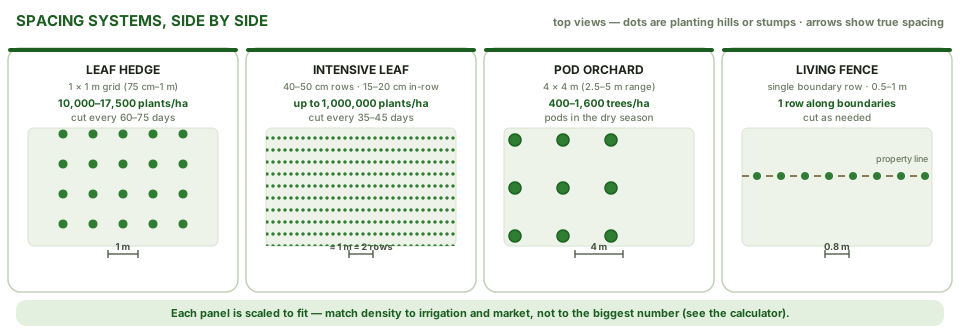
| System | Spacing | Density | Cut interval | Best for |
|---|---|---|---|---|
| Perennial leaf hedge (standard commercial) | 75 cm × 75 cm to 1 m × 1 m | 10,000–17,500 plants/ha | 60–75 days | Fresh leaf + powder farms; the default for PH commercial blocks |
| Intensive leaf (high input, irrigated) | 15–20 cm × 40–50 cm rows | 100,000–1,000,000 plants/ha | 35–45 days | Mechanized forage/powder operations with reliable irrigation and fertility |
| Pod production (annual type, e.g., PKM) | 2.5 m × 2.5 m | ~1,600 plants/ha | — | Drumstick vegetable trade |
| Pod production (perennial native) | 3 m × 3 m to 5 m × 5 m | 400–1,100 trees/ha | — | Seed orchards, agroforestry edges |
| Living fence / boundary | 0.5–1 m in a single row | — | As needed | Boundary security, windbreak benefit, household supply |
Higher density multiplies leaf tonnage per hectare but concentrates nutrient export and demands better water, fertilizer, and faster postharvest handling. Match density to your irrigation capacity and market — not to the biggest number you have read.
6. Fertilization and soil health
Every leaf harvest exports nutrients off the farm. A 40 t/ha fresh-leaf block removes substantial N, P, K, Ca, and Mg each year — replace it or watch yields and leaf quality slide by year two.
Recommended program (leaf production, per hectare per year — adjust to soil test)

| Material | Rate | Timing | Purpose |
|---|---|---|---|
| Well-rotted manure / compost | 5–10 t | At land prep, then ½ top-dress each start of rainy season | Organic matter, slow nutrients, biology |
| Nitrogen (urea 46-0-0 or similar) | 150–300 kg N | Split after each cut (4–6 applications) | Regrowth speed, protein content, leaf color |
| Phosphorus (14-14-14 or 16-20-0) | 50–90 kg P₂O₅ | At land prep; light re-dress yearly | Root development, stand longevity |
| Potassium (0-0-60 / muriate) | 100–200 kg K₂O | Split with N applications | Stem strength, disease tolerance, leaf quality |
| Lime (dolomite) | Per soil test (often 1–3 t) | 3–4 weeks before planting, incorporated | pH correction, Ca/Mg supply |
Organic-certified blocks substitute fermented plant/animal inputs: FPJ (fermented plant juice), FFJ, fish amino acid, vermicompost, and manure teas. Organic powder fetches premiums but certification takes 2–3 transition years — see Processing & Products.
7. Water management
- Establishment (first 8–10 weeks): water 2–3× per week in dry weather. This is when plants die most easily.
- Productive phase: 10–20 mm/week equivalent; irrigate whenever leaves lose sheen or soil is dry at finger depth.
- After each cut: irrigate within 24–48 hours to accelerate flush; this alone can shave a week off regrowth.
- Methods: drip irrigation is ideal for hedges (water efficiency + less weed pressure); furrow irrigation suits flat loams; sprinklers work but wet foliage can encourage leaf diseases.
- Drainage: keep furrows open before the wet season. Standing water for more than 2–3 days can kill plants through root rot.
8. Weeds, mulch, intercropping and agroforestry
Moringa's worst competitor in year 1 is grass. Its best ally is mulch. And its best cash partner is a short-cycle vegetable.
Weed control
- First 8–10 weeks decide the stand. Clean-weed or spot-spray 2–3 times in this window; a hedge that starts smothered never fully catches up.
- Ring-weed each hill 30–50 cm across at establishment, strip-weed the alleys later — cheaper than full-field weeding.
- Never slash close to the stem: moringa's bark wounds easily, and wounds invite termites and rot organisms.
- Herbicide caution: leaf is the product and cuts come fast; if herbicides are used at all, shielded applications between rows before establishment only — never over the crop. Organic blocks: cultivation and mulch only.
Mulching
- Functions: moisture retention through dry spells, weed suppression, soil-temperature buffering, and slow nutrient release as it breaks down.
- Materials: rice straw, cogon, chopped hedge prunings (moringa's own leaves make excellent, nutrient-rich mulch), coconut coir dust, or dry cogon grass.
- Method: 5–10 cm deep, kept 5–10 cm clear of the stem to avoid collar rot; renew after each cut cycle. On sloping land, mulch along contours.
Intercropping program (year 1)
Young hedges leave wide alleys for 4–6 months — use them for cash flow while moringa establishes:
| Companion | Window | Why it works | Cash value |
|---|---|---|---|
| Pechay / mustasa | Weeks 3–9 | Fast (30–40 day) crop between rows; watering shared | Quick first income, 1–2 cycles |
| Munggo (mungbean) | Weeks 2–12 | Fixes nitrogen; thrives in the same season; low water need | One solid cycle per season |
| Kamote (sweet potato) | Months 1–4 | Ground-cover effect doubles as living mulch; tops are a second vegetable crop | Roots + tops for the household market |
| Ginger / luyang dilaw | Months 1–8 | Shade-tolerant as hedge fills; high value per m² | Premium rhizome market at harvest |
| Squash / upo (edge rows only) | Months 1–3 | Only on outer rows where vines can run without climbing the hedge | Volume vegetable income |
Never let an intercrop's fertilizer, pesticide, or irrigation schedule override the moringa program — and never plant anything that needs the alley past month 6. The hedge is the long-term asset; companions are the bridge.
Beyond year one: agroforestry and tree-crop systems
The year-one vegetable program above is a bridge to cash flow. The bigger structural question is what the mature block shares land with — because a moringa hedge under a coconut canopy is a different crop from a moringa hedge in open sun.
| System | Why farmers do it | The conflict to manage |
|---|---|---|
| Malunggay under coconut | The classic Philippine smallholder pattern: coconuts carry the long-term income, malunggay gives the short cycle plus household nutrition | Light. A dense, unmanaged palm canopy starves the hedge — thin the palms or hold the hedge to the row gaps and boundaries |
| Boundary rows and living fences | Uses land you were never going to crop; supplies the household and some side income at almost no extra land cost | Wind. Boundary rows take the first hit, so keep them low and pruned — see design for wind |
| Intercropped with banana | Banana adds a second marketable crop and some wind buffering; both respond to compost and mulch | Competition for water and potassium; a maturing banana canopy shades the hedge within a year or two |
| Alleys of corn or upland rice | Puts the wide row spacing of a young hedge block to work for a seasonal staple or cash crop | Spray drift and fertilizer timing; the cereal's schedule must never override the moringa's |
| Fruit-tree understorey | Reuses mature orchard land and its existing irrigation | Root disturbance while the fruit trees establish — keep planting lines clear of their root zone |
Light, water and the conflicts that actually bite
- Think in leaf area, not in plants. Every companion adds canopy above and roots below. What sets the hedge's yield is the light reaching its regrowth, so judge the system by harvest weight rather than by the companion's price per kilo.
- Orient rows with the companion in mind. East–west rows shade the alley least; north–south rows share light more evenly but shade each other. Decide which trade you are making.
- Water is the real competition. Moringa is drought-hardy but is not a dry-season producer without water. If the intercrop is irrigated and the hedge is not, the hedge loses.
- Fertilizer and sprays follow the moringa program. The year-one rule still holds: a companion crop's schedule never outranks the long-term asset.
- Labour sequencing matters more than you expect. Moringa's cuts are bulk events. If they collide with the companion's harvest peak, one of the two gets done badly — stagger the calendars.
Every intercrop has a date after which it stops paying. A dense hedge shades the alleys from about month 6, and a companion that needs full sun will then fail slowly rather than dramatically — costing you a season before you admit it. Fix the end point at planning time, write it down, and plant the companion where its removal will not disturb the hedge's roots.
9. Pruning and canopy management
Pruning is the core skill of leaf farming. Moringa leafs out on new shoots; unpruned trees go tall, woody, and sparse.

Formative cut (60–90 cm tall)
Cut the main stem back to 30–45 cm to force branching from the base. Do this once, early — it creates the multi-stemmed bush everything else depends on.
Cutting height discipline
Thereafter harvest at 45–60 cm stump height. Cutting below this repeatedly exhausts reserves; cutting above builds a tangled, unproductive stool.
Cut interval
60–75 days for hedges (quality + sustainability); 35–45 days for intensive irrigated blocks. Longer intervals = more woody stem, less tender leaf.
Tool hygiene
Use sharp bolo/loppers; disinfect between sick blocks (chlorine or alcohol). Clean cuts heal fast and reduce dieback entry points.
Rejuvenation
Every 3–5 years (or when stems thicken and flush weakens), cut hard to near ground level at the start of the rains, then topdress with compost and N. Blocks respond with a fresh, vigorous stand.
10. Pests and diseases — IPM for the Philippines
Moringa has fewer serious pests than most vegetables, but several matter at commercial scale:

| Pest / disease | Symptoms | Management |
|---|---|---|
| Leaf webber / caterpillars (Noorda blitealis and relatives) | Webbed leaf clusters, skeletonized leaflets, frass; can defoliate blocks fast in the dry season | Monitor weekly; prune out webbed shoots early; light traps for moths; Bacillus thuringiensis (Bt) sprays on young larvae; conserve parasitoid wasps; avoid broad-spectrum insecticides |
| Aphids | Curled leaves, sticky honeydew, sooty mold on shoot tips | Strong water jets; yellow sticky traps; neem or insecticidal soap; encourage lady beetles and lacewings |
| Mites | Speckled, bronzed leaflets in hot dry spells | Overhead washing; sulfur or horticultural oil where registered; avoid repeated same-mode pesticides |
| Pod fly / fruit fly (on pods) | Pods with maggots, premature yellowing and drop; seed damage | Timely pod harvest; sanitation (destroy infested pods); bait sprays and protein bait traps in pod orchards |
| Termites | Hollowed stems, especially in young plants during dry spells | Avoid wounding stems; remove termite galleries; site-level baiting; maintain soil moisture |
| Root/stem rot (waterlogging, Fusarium/Phytophthora spp.) | Sudden wilting, yellowing, blackened root collar, plant death after standing water | Drainage is the cure: raised beds, open furrows, ridge planting; remove and destroy dead plants; replant on mounds |
| Leaf spot diseases | Brown/black spots in wet season, premature leaf drop | Wider spacing for airflow; avoid late-day overhead irrigation; collect and burn heavily infected flush; copper-based fungicides where registered |
Leaves are the product and are often harvested 60 days after the last spray or less. Only use products labeled for leafy vegetables, observe pre-harvest intervals religiously, and prefer Bt, neem, and biologicals. Powder buyers commonly test for residues — a residue failure can void a contract.
Not sure what you are looking at? The same information as the table above, arranged as a decision path — answer each question and it narrows to a diagnosis with the first actions to take.
11. A Philippine leaf-production calendar
12. Pod and seed production notes
- System: low-density trees (2.5–5 m spacing) allowed to grow tall; pruning limited to shaping and removing dead wood.
- Flowering: triggered mainly by the dry season; pods mature 3–4 months after flowering.
- Tender-pod harvest: pods at 9–12 mm diameter, snapping cleanly — about 60–90 days after flower opening. Handle gently; pods bruise and fibrose quickly.
- Seed harvest: let pods dry on the tree to brown; then harvest, sun-dry 2–3 days, shell, and store seed in airtight containers with desiccant. Viability drops after 6–12 months at room conditions.
- Expected seed yield: mature orchards on good sites report 1–3 t/ha of dry pods; seed fraction is roughly a quarter of pod weight.
Postharvest: fresh tender pods
- Harvest cool and early. Pick in the morning, when pods are turgid and snap cleanly. Cut or twist them free with the stalk attached — pulling tears the pod and opens a bruise.
- Handle like a vegetable, not a field crop. Tender pods bruise, then fibre and darken within a day. Carry them in shallow crates; never in a full sack.
- Market within 24–48 hours. Tender pods have a fresh-vegetable shelf life, not a stored one. If they cannot be sold fresh, they are better dried, pickled, or shelled for immature seed than left to fibrose.
- Grade on the snap. Buyers judge pods by a clean snap at 9–12 mm diameter with a bright colour; over-mature pods showing fibre get discounted or rejected outright.
- Do not wash until sale. Surface moisture invites rot — wipe or rinse only if the market requires it.
Postharvest: dry pods and seed
- Let pods dry on the tree. Seed from green pods has poor viability. Pick once pods are brown and dry, but before they shatter and drop their seed.
- Finish drying in light sun or shade, turned daily. Spread pods on tarps or racks for 2–3 days until they are brittle and rattle. Prolonged full-sun heat can stress seed and lower germination — protect the load at midday.
- Thresh gently. Shell by hand or with a soft beater. Impact threshing cracks seed coats and kills viability, so speed here costs germination later.
- Clean and grade. Winnow or screen out husk and chaff, then discard cracked, discoloured, and insect-punctured seed. A quick float test in water reveals hollow or insect-damaged seed, which float — re-dry the surface afterwards.
- Test germination before storing or selling. Soak 20–50 seed overnight, then keep them damp and warm; viable moringa germinates in roughly 5–10 days. Below about 80% germination, it is not planting-grade material.
- Store airtight, cool, and dark. Seed loses vigour within a year at room conditions. Airtight containers with desiccant in the coolest dark spot available — or a refrigerator for long storage — hold germination up. Label every lot with harvest date and the germination result.
| Destination | Postharvest requirement | Quality signal |
|---|---|---|
| Planting seed | Shade-dried, hand-shelled, cleaned, stored airtight with desiccant | Germination above 80%; plump, uniform, undamaged seed |
| Seed for oil pressing | Dried to low moisture, free of husk and foreign matter | Clean kernel fraction; no mould or rancid odour |
| Seed for water treatment | Sound, mature, well-dried seed; pressed fresh for each use | Coagulation depends on intact, vigorous seed |
| Fresh tender pods | Picked cool into shallow crates, sold within 24–48 hours | Clean snap at 9–12 mm, bright colour, no fibre |
Dry-pod and seed production runs on a different clock from leaf blocks: a low-density orchard cut for pods cannot also be your high-frequency leaf source. Whichever you choose, seed postharvest lives or dies on drying and storage discipline — damaged or aged seed surfaces later as failed germination, rancid oil, or weak water treatment, and the buyer's complaint always arrives after the sale.
Leaf handling has its own dedicated chapter: see Postharvest handling for the cut-to-dryer clock, moisture testing, grading, and storage.
13. Troubleshooting quick table
| Symptom | Likely cause | Fix |
|---|---|---|
| Seedlings die one by one after rain | Waterlogging / root rot | Raise beds, open drains, replant on mounds |
| Pale yellow leaves, slow regrowth | Nitrogen deficiency (or waterlogged roots) | Split N topdress; check drainage before adding fertilizer |
| Thin, sparse canopy after many cuts | Overcutting / exhausted stool | Lengthen cut interval, raise cutting height one cycle, heavy compost + N, rejuvenation cut |
| Leaves small and pale despite fertilizer | Low pH lockout or compacted soil | Soil test, lime, subsoil/plow between rows |
| Webbed, eaten flush | Leaf webber caterpillar outbreak | Prune out webs, Bt spray, monitor weekly next cycle |
| Trees topple in storms | Cutting-raised shallow roots or over-tall hedges | Keep hedges ≤2 m; replant gaps with seedlings; windbreaks |
From the field to the numbers: Economics & Business budgets a leaf block. For handling what you harvest, go to Processing & Products.