 Malunggay Compass
What is malunggay?
Malunggay is the Philippine common name for Moringa oleifera Lam., a small, fast-growing, drought-deciduous tree in the family Moringaceae. It is known worldwide as the drumstick tree (for its long, slender pods), the horseradish tree (for the pungent root), and ben oil tree (for the clear, long-lasting oil pressed from its seeds).
In the Philippines it is best loved as a vegetable: a handful of leaves dropped into tinola or sinigang. Yet botanically it is not a leafy herb — it is a tree that responds to cutting the way a hedge does, which is precisely why intensive leaf farming works.
- Scientific name
- Moringa oleifera Lam. (syn. M. pterygosperma Gaertn.)
- Family
- Moringaceae — a one-genus family with roughly 13 species
- Growth form
- Small to medium tree, typically 5–12 m unmanaged; much shorter under intensive pruning
- Lifespan
- Decades in backyard settings; replanted every 3–5 years in intensive leaf blocks
- Origin
- Northwestern India (foothills of the Himalayas) and adjacent arid zones
- Type of use
- Vegetable, nutritional supplement, forage, oilseed, water-treatment coagulant, agroforestry tree
Malunggay tolerates heat, shrugged-off dry seasons, and poor soils that challenge most vegetables. It is already culturally embedded — every region knows it, eats it, and can name it. Almost no other crop combines cultural familiarity, nutritional value, and agronomic resilience this well.
Names in the Philippines
The crop's ubiquity shows in its many local names. Depending on region, you may hear:
| Name | Where it is used | Notes |
|---|---|---|
| Malunggay | Tagalog, most of Luzon | The national default; used in markets, media, and government materials |
| Marunggay / Marungay | Ilocos, Cagayan Valley (Ilokano) | Common in the Ilokano-speaking north, where the largest commercial leaf areas are found |
| Kalunggay / Kamunggay | Visayas (Hiligaynon, Cebuano areas) | Widely grown in farm hedges and coastal yards |
| Sajina / Sajjina | Parts of Bicol and Eastern Visayas | From the older Spanish-era trade name malunggay ← moringa |
| Dool / Dulum | Some Mindanao lumad communities | Regional usage; standard names still understood in markets |
Spelling varies locally — malungay, malunggáy, marunggai — but all refer to Moringa oleifera.
Origin and global journey
Plant morphology
Root system
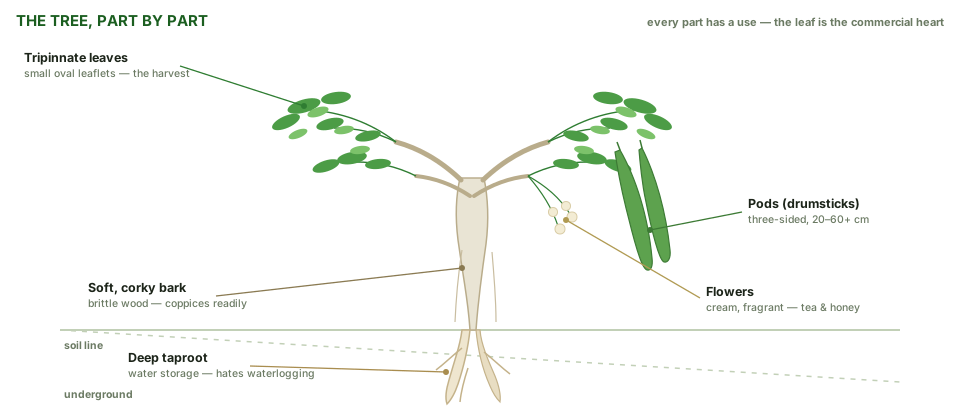
Malunggay grows a deep, fleshy taproot with sparse lateral roots — the key to its drought survival. The taproot stores water and can reach several meters in loose soils, but it also means the tree dislikes waterlogging: saturated clay suffocates the root crown quickly.
Stem and branches
The trunk is soft-wooded, pale, corky-barked, and brittle; branches droop as the tree matures. Wood is light (low density) and burns poorly as fuel, which is one reason the tree is not a firewood favorite. Under repeated cutting, the stem produces a mass of basal shoots — the physiological basis of intensive leaf production.
Leaves
Leaves are bipinnately or tripinnately compound, 20–60 cm long, with small oval leaflets (1–2 cm) that drop easily in drought or shade. The leaflets are the harvested product: tender, dark green, and extraordinarily rich in protein and micronutrients for a plant tissue.
Flowers
Fragrant, cream-white, about 1–1.5 cm across, borne in large drooping panicles. In the Philippines, flowering responds to the dry season, with pods mainly in the hot months. Bees visit heavily; honey from moringa-dominant areas is prized.
Pods (drumsticks)
The pods are three-sided capsules, 20–60+ cm long, hanging like green beans on steroids. Young pods (9–12 mm diameter) are the tender, edible stage sold as a vegetable. As they mature they harden, dry, and split to release seeds.
Seeds
Each pod holds 10–20 seeds in three longitudinal rows. Seeds are roundish, winged at the corners, with a brittle hull and a white kernel rich in oil (30–40%) and the water-purifying proteins covered in Processing & Products.
🌿 Leaves
The commercial heart of the crop — fresh vegetable and dried powder. Fastest to produce, most forgiving to manage.
🫛 Pods
Pod type varieties at low density yield market drumsticks for vegetable markets in season.
🌰 Seeds
Oil pressing, seed-for-sowing, and water-treatment coagulant — a smaller but higher-value market.
🌸 Flowers
Harvested for tea and honey production; in some provinces, flower fritters are a seasonal delicacy.
🪵 Wood & bark
Soft, light wood: handicrafts, light construction, and paper pulp in some countries; little commercial value locally.
🪴 Roots
Horseradish-flavored condiment in folk use; bark and root preparations appear in traditional medicine. Handle with care — see safety notes.
Seasonality and regional behavior
Malunggay never goes fully dormant in the Philippines, but its behavior follows the monsoon rhythm — and that rhythm shapes markets, prices, and farm calendars.
| Season | What the tree does | What it means on the farm & market |
|---|---|---|
| Late dry season (Mar–May) | Heavy flowering; leaf flush slows on unirrigated trees; pods set and fill | Fresh-leaf supply dips → market prices peak; pod season at its height; irrigated farms earn their keep |
| Wet season onset (Jun–Aug) | Vigorous vegetative flush; flowering pauses; disease pressure rises (leaf spots) | Leaf supply floods markets → farmgate prices sag; best planting window; drainage checks critical |
| Late wet season (Sep–Nov) | Steady leaf growth; typhoon exposure peaks | Storm breakage risk; keep hedges low; windbreaks prove their worth |
| Cool-dry (Dec–Feb) | Growth continues in lowland areas; slower in elevated towns; early flowering in Type I climates | Reliable supply; good cut-and-carry period before the dry-season price run-up |
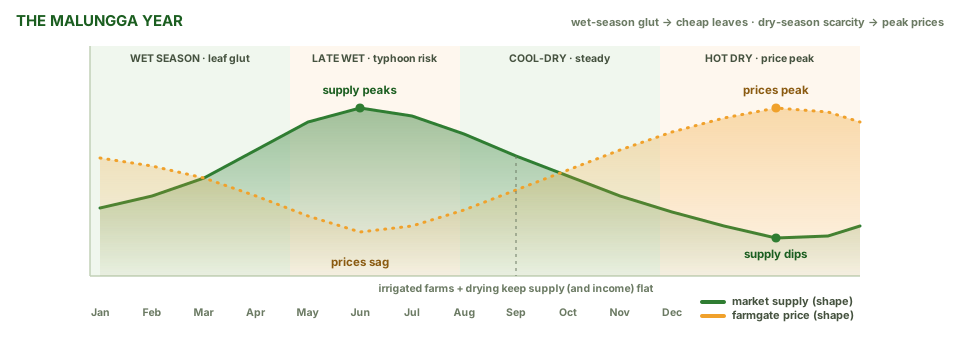
Wet-season gluts and dry-season scarcity are the fresh-leaf market's heartbeat. The fix is timing (staggered cuts, irrigated dry-season production) or processing (drying surplus into powder) — see price mechanics and water management.
Growth behavior and ecology
Several traits explain why moringa is what it is — and how to farm it well:
- Drought-deciduous: it sheds leaves to survive drought, then flushes vigorously when water returns. Irrigation during dry months keeps the canopy productive year-round.
- Rapid biomass accumulation: under warm, moist conditions, shoots can elongate several centimeters per day, allowing first leaf harvests in 60–90 days.
- Coppicing response: cutting hard triggers multiple new shoots from the stem and crown — the more you manage it, the denser the leaf production.
- Light demand: full sun is essential. Shaded plants become leggy, sparse-leaved, and pest-prone.
- Frost and typhoon sensitivity: no frost tolerance; soft wood and compound leaves make it vulnerable to strong wind, which argues for windbreaks in typhoon-exposed farms.
From planting to steady state: the first 18 months
The traits above explain the tree's temperament; the timeline below shows what that temperament means in practice — what the plant is doing underground and above ground at each stage, and what a farmer should be doing to match it. Dates assume warm lowland conditions and reasonable care; elevated or cooler sites run a few weeks slower.
Pod-bearing trees follow a different clock — first pods around months 8–12 on uncut trees, full commercial podging in season two. Every hard leaf cut delays podding; that is the tradeoff encoded in the spacing systems.
Malunggay in rural life and folklore
Ask a Filipino farmer about malunggay and you rarely get a botany lecture — you get stories. The tree is woven into rural life:
- The fence that feeds: planted along boundaries and around gardens, malunggay doubles as living fence, windbreak, and vegetable patch — “the tree you argue with daily at the kitchen door.”
- Sharing culture: a tree overloaded with pods is a neighborly obligation; bunches cross fences all season. In many villages, selling malunggay to a neighbor was once quietly frowned upon — prices were “for the viajero, not the kabarangay.”
- Folk medicine: leaf poultices for wounds and boils, leaf tea for fevers and anemia (“dagta ng gulay,” some elders call the iron-rich broth), and bathing washes from boiled leaves for tired legs. These uses persist alongside — not instead of — clinics.
- Beliefs and cautions: some regions hold that malunggay should not be cut after dark (bad luck, or the tree “bleeds”); others say a flowering tree foretells a good year. Dairy folklore in some areas warns against feeding it to carabaos before milking — farmers' own version of the crop's potent biochemistry.
- Rites and recovery: after typhoons, the first vegetable back on the table is often malunggay — it resprouts fastest, and a tinola from storm-felled branches became a symbol of getting back on one's feet.
Cultural familiarity is a market asset: no consumer education is needed to sell the fresh leaf. But folklore also caps prices — “it grows anywhere, why pay much?” The industry's task, and the processor's opportunity, is transforming free-backyard perception into quality-based value.
Lookalikes and common confusions
- “Malunggay” vs “malunggay”: sellers sometimes mix M. oleifera with other Moringa species or with unrelated “tree vegetables.” True malunggay has tripinnate leaves with tiny oval leaflets and three-sided pods.
- Katuray (Sesbania grandiflora) is a different tree with larger white flowers eaten as a vegetable; its pods are flat and broad, not three-angled.
- Malunggay seed vs. castor-like lookalikes: dried pods from unknown trees should not be used for sowing or consumption — verify the source tree's identity first.
Still unsure? Answer two or three questions and the check below narrows it down — including the mistake that matters most, using seed from a tree nobody can identify.
Next, see Varieties & Selection for the species and cultivars worth planting, or jump to Cultivation Guide for the full farming manual.