 Malunggay Compass
This chapter is a planning map, not legal advice. Requirements, fees, and agency procedures change; the authoritative sources are the Food and Drug Administration (FDA), the Department of Agriculture's Bureau of Agriculture and Fisheries Standards (DA-BAFS), and the certifying bodies themselves. Confirm the current checklist with your Municipal Agriculture Office and the FDA before you spend on a facility.
1. Why compliance is the real barrier
Most moringa in the Philippines is sold as fresh leaves in wet markets, where the transaction is a bundle of leaves and a handful of pesos. The moment you move up — branded powder, tea, capsules, cosmetics inputs, institutional supply, or export — you leave the informal market and enter the regulated one. That is where the margin is (see the value-added math), and it is also where almost every new entrant stalls.
The reason is sequencing. Compliance is not one certificate you buy at the end; it is a chain in which each link requires the one before it. You cannot register a product without a licensed facility. You cannot get most certificates without documented records that only exist if you built the record-keeping in from the start. And you cannot retroactively create the batch records that an auditor will ask for.
Build the paperwork into the process, not on top of it. A drying log you fill in while drying costs nothing; a drying log you reconstruct three months later, to convince an auditor, does not exist.
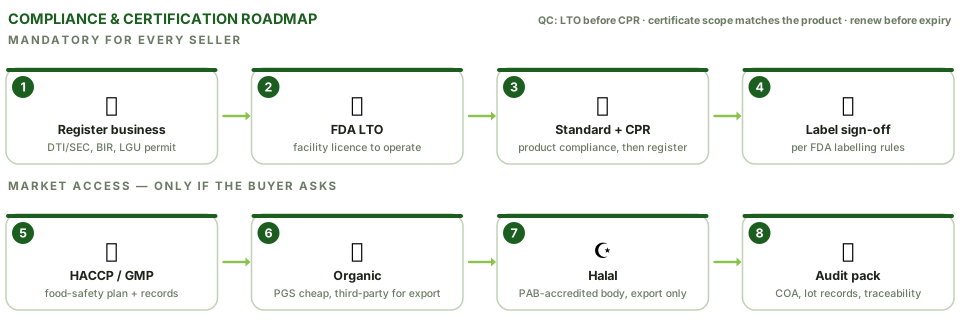
2. The mandatory floor: every food seller
Four things stand between a farm and a legally sold packed food product. They apply whether you sell 20 kilos or 20 tonnes.
1 · Register the business
DTI (sole proprietor) or SEC (corporation/partnership) registration, then BIR registration, then the LGU mayor's permit for the specific address where you will process. The address matters: your FDA licence will be tied to it.
2 · FDA License to Operate (LTO)
Under Republic Act 10611, the Food Safety Act of 2013, food establishments must hold an LTO from the FDA (DOH) for the activity on the licence — manufacturing, repacking, trading, or distributing. An LTO is issued to the facility, not the product, and requires the premises to meet GMP expectations.
3 · Product standard, then CPR
The product must comply with the applicable standard, after which you secure a Certificate of Product Registration (CPR). Per DOH Administrative Order 2014-0029 the CPR runs from two to five years for an initial application, with five-year renewals. You cannot get a CPR without a valid LTO first — this ordering catches most first-timers.
4 · Compliant label
Label content is prescribed: product name, net weight, ingredient list, manufacturer/packer and address, lot or batch code, best-before date, storage instructions, and nutrition information where required. Health claims are the sharp edge — see the mistakes.
| What | Issued to | Typical validity | The common blocker |
|---|---|---|---|
| FDA Licence to Operate (LTO) | The facility / activity | Per FDA schedule, renewed | Premises fail GMP on inspection: no handwash station, no separated dry/wet area |
| Certificate of Product Registration (CPR) | Each product, each SKU | 2–5 years initial, 5 years renewal | Applied before the LTO existed; or label claims the reviewer rejects |
| Mayor's permit & BIR registration | The business, at an address | Annual | Processing at an address other than the registered one |
3. GMP, SSOP and HACCP
These three acronyms appear together so often that they get treated as one thing. They are a ladder, and the rungs do different jobs.
| System | What it actually is | What it costs you in practice |
|---|---|---|
| GMP — Good Manufacturing Practice | Prerequisite conditions: premises, layout, water, pest control, personnel hygiene, equipment, sanitation, training. | Money: physical facility works. This is where the capital goes, and where an LTO inspection will fail you. |
| SSOP — Sanitation Standard Operating Procedures | Written procedures for cleaning, sanitising, pest control, and water safety, plus the records proving you did them. | Discipline: a signed cleaning log per shift. Nearly free, and nearly always missing. |
| HACCP | A preventative system: identify hazards (biological, chemical, physical), determine critical control points, set limits, monitor, correct deviations, verify, keep records. | Time and consultancy. For moringa powder the critical controls cluster at drying, metal detection/sieving, and moisture — see drying. |
For a moringa operation, HACCP is not abstract. Your hazard analysis will almost certainly land on four points: moisture/water activity (drives mould and aflatoxin), foreign matter (stones, metal, plastic from field and mill), microbiological load (potable water for washing, hands, and drying surfaces), and allergen/other-material cross-contact if you dry or mill moringa on the same line as anything else. Note the GMP checklist in the Processing chapter for the physical layout side.
4. Organic certification
“Organic” is a legally controlled claim, not a description. In the Philippines it runs through Republic Act 10068 (Organic Agriculture Act of 2010, amended by RA 11511), the National Organic Agriculture Program, and the Philippine National Standard for Organic Agriculture, PNS/BAFS 07:2016 — which covers conversion, crop production, animal production, beekeeping, processing, and special products. Certifying bodies must be accredited by DA-BAFS.
There are two routes, and the cost difference between them is roughly two orders of magnitude. Choosing correctly is one of the highest-value decisions a small moringa enterprise makes.
🤝 PGS — Participatory Guarantee System
A locally organised, peer-review system where farmers inspect and vouch for each other against the standard. DA-BAFS recognition of PGS groups is the point.
- Cost: reported in the range of a few hundred to a couple of thousand pesos for farmer members — the cheapest legitimate route to an organic claim.
- Fit: cooperatives, clusters, and direct-to-consumer local sales.
- Limit: not automatically the certification an export buyer or a large processor wants.
🏛️ Third-party certification
A DA-BAFS-accredited certifying body audits your operation and issues a certificate against PNS/BAFS 07:2016. Accredited bodies include Control Union Philippines and the Organic Certification Center of the Philippines (OCCP), among others.
- Cost: commonly cited in the tens of thousands of pesos per year for smallholder operations (figures in the ₱20k–65k range are reported), valid around 12 months before renewal.
- Fit: supply to processors, brands, and export chains.
- Limit: annual cost and audit overhead, and a conversion period during which you are “in conversion”, not “organic”.
A Philippine organic certificate does not automatically satisfy a US or EU importer. Selling as organic into those markets means meeting the destination rule set — USDA NOP or EU organic equivalence — which usually means certifying through an international body. Ask the buyer which scheme they require before paying for certification. And note the land-history rule: organic status generally requires a conversion period after the last prohibited input, so the clock starts the day you stop using them, not the day you apply.
5. Halal certification
If your end market includes Muslim-majority countries — and a large share of the Gulf food trade does — halal certification is the entry ticket, not a marketing extra. The legal framework is Republic Act 10817, the Philippine Halal Export Development and Promotion Act of 2016, which created a Halal Board as the policy-making body and tasked the Philippine Accreditation Bureau (PAB) with accrediting halal certification bodies.
Two practical consequences matter for a producer:
- For export, the certifying body must be Philippine-accredited. Under the law's implementing rules, only goods certified by Philippine-accredited halal certification bodies may be exported as halal. A certificate from an unaccredited body does not open that door, however impressive it looks.
- The Philippines is active in the international halal accreditation network (a full member of the International Halal Accreditation Forum), which is what makes Philippine-issued halal certificates recognisable abroad. Ask your prospective certifier which foreign schemes their accreditation is recognised under.
Recognised Philippine halal certification bodies have included the Islamic Da'wah Council of the Philippines and others; the accredited list changes over time, so verify the current roster with PAB before contracting.
6. Testing and the COA
A Certificate of Analysis (COA) is the document that turns your claim into a fact another party can check. Buyers increasingly ask for one per lot, not per year, and this is where under-dried or carelessly handled powder is exposed.
| Test group | Typical parameters | Why the buyer asks |
|---|---|---|
| Moisture / water activity | Moisture %, water activity | Shelf-life and mould prediction; the single strongest quality signal |
| Microbiology | Total plate count, coliforms, Salmonella, yeasts and moulds | Food-safety release; fails fast if drying or hygiene is weak |
| Heavy metals | Lead, cadmium, arsenic, mercury | Regulatory limits in destination markets; soil-dependent |
| Mycotoxins | Aflatoxin | Directly linked to moisture and storage failures |
| Pesticide residues | Multi-residue screen | Required if you claim organic; catches drifts and shared equipment |
| Nutrition panel | Protein, fat, fiber, ash, vitamins/minerals as claimed | Substantiates your printed label claims |
A laboratory result is only as good as the sample you submit. Take samples from the finished, packed lot — not from the top of the drum — seal them, label them with the lot code, and keep a retention sample of the same lot. If a buyer disputes a result, your retention sample is your only defence. Note that a COA from an accredited lab also carries more weight than an in-house reading on a handheld moisture meter, which is suitable for process control but not for release.
7. Lot coding and traceability
Traceability is the ability to go from a finished pack back to the field block and the drying batch — and forward again if a problem appears. It is what makes a recall a file review instead of a public-relations disaster, and commercial buyers audit for it.
A workable scheme for a small operation, readable on a printed label:
For example, BLK2 / 2603-14 / SUN-07 / M-114 says: block 2, harvested 14 March 2026, dried in sun batch 07, milled in run 114. Four records make that code work — and all four are one-line logs you fill in at the time:
📋 Harvest & drying log
Date, block, weight in, method (sun / solar / mechanical), temperature or sun-hours, weight out, operator initials.
⚙️ Milling & packing log
Date, input batch, mill setting, mesh, output weight, metal-check result, pack count, lot code applied.
The reconciliation that auditors look for is mass balance: kilos in should approximately equal kilos out plus documented loss. If your drying log says 500 kg fresh went in and your packing log says 140 kg of powder came out, that ratio is your verification — and a ratio that drifts is an early warning that something changed.
8. Realistic cost and timeline
Compliance is not a one-off purchase; it is a recurring operating cost with a setup phase. Budget for the shape below, then get real quotes for your own scale.
| Stage | Main cost drivers | Recurs? |
|---|---|---|
| Business registration & permits | DTI/SEC, BIR, mayor's permit, bookkeeping | Annual plus one-off |
| Facility to GMP standard | Screened drying area, wash area, storage, pest control, water testing — the largest single line | One-off plus upkeep |
| FDA LTO + CPR | Agency fees (scale with product/activity), label review, possible consultancy | Renewal cycles |
| Food-safety system | HACCP documentation, training, possibly consultancy | Occasional revalidation |
| Per-lot laboratory testing | Accredited-lab panels | Per lot / per shipment — a variable cost that must sit in your unit price |
| Organic (if claimed) | PGS a few hundred to a couple of thousand pesos; third-party certification reported in the tens of thousands per year | Annual |
| Halal (if exporting) | Certification and audit fees via a PAB-accredited body | Renewal cycle |
The trap is treating certification as a parallel shopping list. The realistic order is: facility → GMP → LTO → product standard → CPR → label, with organic, halal, and testing added only as specific buyers require them. Skipping ahead means paying for applications that cannot be approved yet. Your MAO, the DA's High-Value Crops Development Program, and PhilMech support (dryers, mills, shared processing facilities) can absorb part of the facility cost — ask before you borrow.
9. The mistakes that cost the most
🚫 Filing before the facility is ready
An LTO application on premises that cannot pass GMP wastes the fee and the months. Fix the wash area, the drying floor, and the storage first.
🏷️ Health claims on the label
Moringa has genuine traditional and researched uses, but a food label cannot carry drug claims. Over-claiming is the fastest route to a rejected label or a recall — see the honest evidence summary.
📄 Certificate scope mismatch
An organic certificate that covers your farm but not your processing line, or an LTO for “trading” when you actually manufacture, is worse than none — it looks compliant and is not.
⌛ Letting certificates lapse
Renewal dates are operational deadlines. A lapsed organic certificate means you must stop using the word mid-season, and a lapsed CPR can pull product off a shelf.
☀️ Sun-drying into a micro failure
Open sun drying on a mat in a dusty yard is the most common cause of failed microbiology and mould counts. Covered solar or mechanical drying is a compliance investment, not a luxury.
🧾 No records until an audit
Records created for the audit are visibly created for the audit. Continuous logs are the only ones that survive scrutiny and the only ones that help you improve yield.
Before spending anything: (1) name the buyer and ask which certificates they require; (2) register the business and the processing address; (3) fix the facility to GMP; (4) apply for the LTO; (5) only then pursue the CPR and any market-access certificates. Everything else is optional until a buyer makes it compulsory.