 Malunggay Compass
1. Why moringa is wind-fragile
Three properties of the plant work against it in high wind, and all three are visible in the plant description.
- Wood is light and brittle. Moringa grows fast because it builds low-density wood. Fast growth is a yield advantage in the canopy and a structural liability in a storm: limbs snap rather than flex.
- Root anchorage depends on how you propagated it. Seed-grown plants develop a strong taproot and hold far better than cuttings, which root shallowly and fibrously. A cutting-raised block that yields fast can also lodge flat in one night. This is the same trade-off noted in the propagation and FAQ chapters, and in a typhoon belt it usually decides the answer.
- Canopy height is sail area. An unpruned tree 8–12 m tall presents an enormous lever arm on a brittle stem. The same plant kept as a 1–2 m bush presents a fraction of the load.
The commercial leaf system — frequent cutting, low stumps, dense hedges — happens to be the most storm-resilient configuration as well. A well-managed leaf hedge at 45–60 cm stump height is close to the ideal low-profile form. The vulnerable farm is the one chasing pod or seed production with tall, lightly pruned trees in an exposed site.
2. The four hazards
| Hazard | Early signal | What it does to the crop | First response |
|---|---|---|---|
| Wind / typhoon | PAGASA advisories; seasonal peak from roughly June to November | Branch snap, defoliation, lodging of cutting-raised plants; splintered stumps that rot | Pre-season prune to a low profile; document for claims; cut back cleanly after |
| Drought | Midday wilting, declining flush size, dry riverbeds and wells | Leaf drop and stalled regrowth — output collapses exactly when dry-season prices rise | Irrigate the most valuable blocks first; mulch heavily; defer cuts rather than forcing them |
| Flood / waterlogging | Standing water after 24–48 hours | Root rot, yellowing, dieback. Moringa tolerates dry far better than wet | Open drainage immediately; never site a block in a closed depression |
| Heat and salt | Sustained high temperatures; coastal spray during storms | Leaf scorch, flower and pod abortion; tip burn in exposed coastal plantings | Shade and wind protection for nursery stock; establish windbreaks in coastal sites |
3. Know your zone before you plant
Four characteristics determine whether a site is a good moringa site or an expensive lesson. Write them down for your barangay and keep them with your farm records.
🌀 Typhoon exposure
Eastern-facing coasts and the recognised typhoon belts (much of Eastern Visayas, Bicol, Cagayan Valley, and northern Luzon) take more landfalls and stronger winds than sheltered interiors. If you are in a belt, plan for breakage as a routine annual event, not an emergency.
☔ Rainfall pattern
Is the dry season three months or five? A long, reliable dry season is an advantage for leaf drying but a threat to unirrigated production. Irrigation access — not total rainfall — is the deciding variable.
⛰️ Slope and drainage
Gentle slope with free drainage is close to ideal: it sheds storm water while holding enough moisture. Flat, low-lying, clay-heavy ground is the risky profile.
🧂 Coastal salt
Within a few hundred metres of the shore, wind-borne salt during storms will scorch exposed foliage. A protective windbreak of a sturdier species changes what is possible.
4. Design for wind
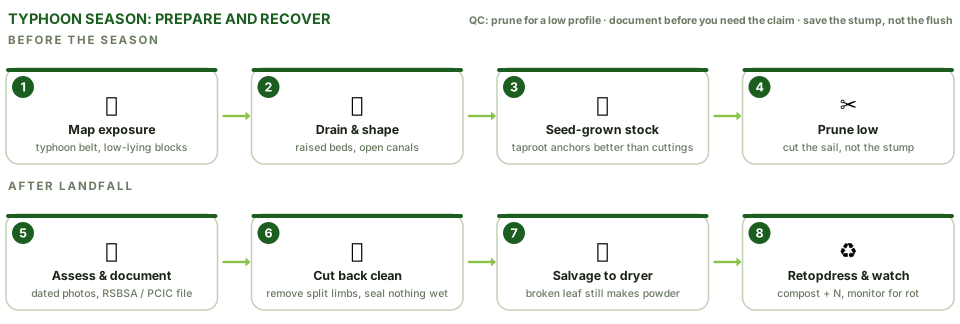
Wind resilience is bought with three things: layout, plant architecture, and propagation choice. None of them can be retrofitted in the week a storm is named.
Site layout
- Orient rows across the prevailing storm wind rather than along it. A row is a partial barrier; rows aligned with the wind create a channel.
- Plant a windbreak of a sturdier species on the exposed boundary, ideally on more than one side in coastal sites. A porous barrier (aim for roughly half-open, not a solid wall) reduces wind speed over a distance of several times its height; a solid wall simply creates damaging turbulence on the lee side.
- Keep moringa out of the windbreak's windward row. The plant that needs protecting should not be the one taking the first hit.
- Group blocks so that young plantings sit leeward of established hedges. Newly planted or nursery stock is the least anchored material on the farm.
Plant architecture
- Prune to a low profile before the season. A hard cut in the dry months produces a compact, multi-stemmed bush with flexible young regrowth instead of tall brittle wood. Tall trees snap above the stump; bushes lose leaves and regrow.
- Cut back rather than "thinning for airflow". On a brittle species the goal is a low centre of mass, not a pruned-up canopy with long lever arms.
- Protect the stump over the flush. Leaf can be regrown in weeks; a split, rotted stump is a dead hill.
Propagation choice
| Question | Seed-grown plant | Cutting-raised plant |
|---|---|---|
| Root system | Strong taproot | Shallow, fibrous |
| Anchorage in wind | Markedly better | Prone to lodging in exposed sites |
| Time to first harvest | Slower | Faster |
| Best fit | Exposed and typhoon-belt sites; pod orchards | Sheltered, irrigated, short-cycle leaf blocks |
5. Water: too much and too little
Both water extremes are manageable, and both are cheaper to design than to fight.
Drought
- Irrigate, don't hope. The headline yields in this knowledgebase assume water on demand; the calculator's 45 t/ha intensive figure is explicitly an irrigated number.
- Mulch heavily. Thick organic mulch is the cheapest water-storage device on a small farm and rebuilds the soil at the same time.
- Protect the canopy. Reduce cut frequency under stress instead of forcing flushes; a deferred cut keeps the plant alive to cut again.
- Sequence the blocks. If water is limited, concentrate it on the most productive or most contracted block rather than spreading it thin.
Flood and waterlogging
- Raise the beds. Ridged or raised planting lines keep crowns above standing water and turn a kill into a setback.
- Cut open drainage before the rains, not after the flood. Canals, field drains, and clear outfalls are pre-season work.
- Never site a block in a closed depression. No amount of agronomy fixes a pond.
- Watch for rot after any flooding. Yellowing with soft, dark tissue below the crown is a root problem, not a nutrient one — see the troubleshooting table.
6. The post-storm protocol
Do these in order. The order is the whole point: undocumented damage cannot be claimed, and unrecorded harvest weight cannot be reconciled.
1 · Wait for safety, then walk the farm
Leaning trees and hanging limbs are dangerous for days. Once it is safe, walk every block on foot and note block, damage type, and extent.
2 · Document before you clean up
Dated photographs of damaged blocks, stems, and stumps — ideally geotagged — plus a written estimate of area and loss. This is the evidence base for any insurance claim. Clean fields erase claims.
3 · Salvage to the dryer
Broken leaf and branch material that is still clean and green is saleable powder. Get it off the ground and into drying fast; a salvageable harvest left lying in humid air becomes mould within a day or two.
4 · Cut back to clean wood
Make clean cuts below splintered or split tissue, and remove torn limbs entirely — ragged stubs collect water and rot into the stump. Disinfect tools between damaged and healthy blocks to avoid spreading infection into fresh wounds.
5 · Retopdress, then leave it alone
Compost plus a nitrogen dose after the cut supports the regrowth flush. Then resist the urge to over-harvest the recovery: the first post-storm flush is the plant rebuilding its reserves.
6 · Record and review
Log what failed and why — which block leaked water, which rows lodged, which propagation batch held. That log is what makes next season cheaper than this one.
7. Crop insurance and the RSBSA
Agricultural insurance in the Philippines is delivered largely through the Philippine Crop Insurance Corporation (PCIC), a government corporation. Its product lines cover rice, corn, high-value crops, livestock, and fisheries and aquaculture — and moringa, as a high-value crop, sits inside that structure rather than outside it.
| Element | What to know |
|---|---|
| Eligibility gate | Enrolment in the Registry System for Basic Sectors in Agriculture (RSBSA) is the standard requirement for accessing PCIC crop insurance and most DA support programmes. Register through your MAO — it is also the door to the HVCDP support in the next chapter. |
| Indicative premium | Published rates have been on the order of 10% of the sum insured for rice and corn and about 3% for high-value crops. Treat these as indicative only: the rate depends on crop and programme, and must be confirmed with PCIC for the current season. |
| Subsidised cover | Government has run subsidised or free crop insurance for RSBSA-listed farmers across several product lines. Whether your crop and season qualify is a question for your MAO, not an assumption to build a budget on. |
| What you must keep | Proof of planting, area, and standing crop; dated damage evidence after the event; and prompt notification of loss. Late reporting is the most common reason a legitimate loss is not paid. |
Notice that the insurance file and the compliance log want the same things: dates, blocks, weights, and photographs. A farm that already keeps harvest and drying logs has most of a claim file sitting in a notebook. A farm that keeps nothing has a story — and stories are not paid.
8. Enterprise resilience
Resilience is not only agronomic. A farm with one product, one buyer, and one harvest window is brittle in exactly the way an unpruned tree is.
- Stagger the planting calendar. Blocks planted months apart do not all sit at the same vulnerable growth stage when a storm arrives.
- Carry a processing buffer. Being able to convert a distressed fresh harvest into dried powder within 24 hours is the single most valuable piece of storm-proofing a leaf farm can own — see drying.
- Match enterprises to the season. Pod and seed production on tall trees is a dry-season, sheltered-site enterprise; leaf hedges are the resilient base load.
- Spread the customer base. The market channels have very different storm behaviour — wet-market demand spikes after a storm, contract powder buyers want continuity.
- Keep working capital. The cost of a storm is rarely the lost crop alone; it is the replanting and the gap before the next harvest. Cash flow is the thing that fails.
9. The readiness calendar
Every resilience measure has a cost and a small delay: seed-grown stock establishes more slowly, a hard pre-season prune forgives a harvest, mulch and drainage consume labour. The honest comparison is not “resilience versus yield” but “a slightly smaller harvest every year versus no harvest in some years.” Over a decade in a typhoon belt, the low-profile hedge wins on arithmetic as well as on nerve.