 Malunggay Compass
- Who actually buys Philippine moringa
- What form to export
- Are you exportable yet?
- The documentation stack
- Market-by-market basics
- Finding & qualifying buyers
- Pricing, Incoterms & payment
- Logistics & consolidation
- Samples, specs & lots
- What goes wrong
- A three-year route to a first shipment
- Export readiness checklist
Requirements in the tables below are planning summaries, not regulatory advice, and destination rules change frequently. Every market entry should be confirmed with your importer, the Philippine FDA and BPI, a licensed customs broker, and — for organic or halal — the certifying body itself. Nothing here replaces those four conversations.
1. Who actually buys Philippine moringa
There are four buyer types, and only one of them is realistically reachable in your first year.
| Buyer type | What they buy | Typical order size | What they demand |
|---|---|---|---|
| Ethnic / Filipino grocery importers | Retail packs of powder, tea, capsules; frozen and other Philippine foods alongside | Hundreds of kilos to a few tonnes per order | Philippine-made authenticity, US/EU-compliant labels, FDA-type registrations, and often willingness to carry the risk of unsold stock |
| Ingredient wholesalers & distributors | Bulk powder in drums, sacks or totes | Tonnes per shipment | Consistent specification, certificates of analysis per lot, food-safety certification, and trial quantities before commitment |
| Brands and private-label customers | Powder packed under their label, or finished capsules and tea bags | Modest at first; container-scale once a product sells | Specification discipline, packaging capability, on-time repeat supply, and the ability to survive an audit |
| Organic and specialty traders | Certified-organic leaf, seed, and oil | Tonnes, contract-based | Recognised organic certification, traceability to the farm, and documentation of inputs |
2. What form to export
Export value rises with processing, but so does the barrier. Choose the row you can actually sustain for a year:
| Form | Value per kilo | Buyer difficulty | Where it goes |
|---|---|---|---|
| Fresh leaf | Lowest | Not exportable in practice | Nowhere. A 24-hour product does not cross an ocean — see fresh-market reality. |
| Dried leaf / leaf meal | Low | Moderate | Animal-feed ingredient trade; occasionally as input for foreign processors |
| Food-grade leaf powder | The workhorse | Moderate to high | Ingredient wholesalers, ethnic groceries, private-label brands, supplement manufacturers |
| Tea and blends | Higher | High | Retail brands, ethnic groceries, gift and wellness channels |
| Capsules / finished dose forms | Higher still | Highest | Requires destination registration for supplements, contract manufacturing relationships, and shelf-life studies. |
| Seed oil (ben oil) | The premium | Very high | Cosmetics and personal-care manufacturers, where a specification and a supply guarantee matter more than price |
3. Are you exportable yet?
Export buyers do not ask how many hectares you have. They ask four questions, in this order. Answer them before writing to anyone:
Can you supply the same product twice?
Not "a good batch" — the same mesh, colour, moisture, microbiology and taste, order after order. This is the single hardest thing for a small moringa operation, and the one buyers care about most.
Can you fill their minimum order without going broke?
A first bulk order of a few tonnes of powder represents a large quantity of fresh leaf and a lot of working capital. Work the volume backwards through your own fresh-to-dry ratio and see whether you can finance it.
Can you survive the payment delay?
Export payment terms mean you fund production, processing, packing and freight before money arrives. This is the constraint that stops most otherwise-ready growers — see working capital.
Can you produce a document pack on demand?
Lot code, COA, specification sheet, labels, permits, and a traceable path back to the block. If assembling that pack takes three weeks, you are not ready yet.
Take the buyer's minimum: say 5 tonnes of powder. At a 4–5:1 fresh-to-dry ratio that is roughly 20–25 tonnes of fresh leaf — several hectares' annual production, all of it needing to be dried, milled, tested and packed on schedule, not "when the weather allows." Run that arithmetic before you reply to an inquiry; it is cheaper than discovering it after you have committed.
4. The documentation stack
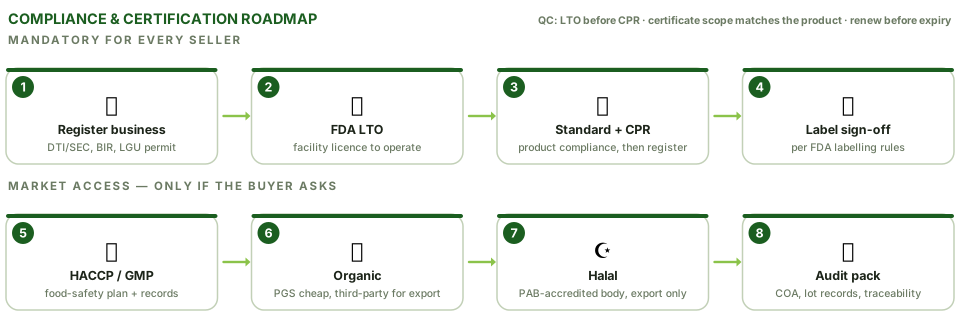
Export paperwork is a stack, and each layer needs the layer above it. Build from the bottom:
| Layer | Document | Issued by / where | When it applies |
|---|---|---|---|
| 1 · Business | DTI or SEC registration, BIR, LGU permit, export-oriented enterprise registration | DTI / SEC / BIR / LGU | Always |
| 2 · Food safety | FDA Licence to Operate (LTO), Certificate of Product Registration (CPR) | FDA Philippines | Always, for processed food |
| 3 · Plant health | Phytosanitary certificate; plant quarantine clearance as required | DA–Bureau of Plant Industry (BPI) | Plant-origin goods on most markets |
| 4 · Origin & tariff | Certificate of origin; ATIGA Form D for intra-ASEAN preferential tariffs | BPI / DTI / Chamber of Commerce, as applicable | When a tariff preference is claimed |
| 5 · Commercial | Commercial invoice, packing list, bill of lading or airway bill, insurance certificate | You, the forwarder, the carrier | Every shipment |
| 6 · Quality | Certificate of Analysis per lot (moisture, microbiology, heavy metals, as required), specification sheet, retention sample | Accredited laboratory | Preferred on every lot; required by most buyers |
| 7 · Buyer-specific | GFSI-type food safety scheme (BRCGS, FSSC 22000, SQF), organic certificate, halal certificate, social compliance audits | Accredited certifying bodies | Only when a named buyer requires it |
| 8 · Destination | Importer-side registrations and programmes (see market table) | Your importer, in their country | Per market |
5. Market-by-market basics
| Market | Demand shape | Importer-side requirements to expect | Practical notes |
|---|---|---|---|
| United States | Largest single destination; strong Filipino and health-food demand; supplement brands | Food facility registration for the foreign facility; the US importer carries Foreign Supplier Verification Program duties; prior notice on each shipment; US-format labelling including Nutrition Facts and dual net-weight declarations; USDA organic if claimed | Label compliance is the most common failure point. Have a US-registered importer who knows the rules, and get the label reviewed before printing. |
| European Union | Health-food, organic and ingredient demand; premium prices for certified organic | Importer responsibility for compliance; organic imports must be certified under the EU organic regime by a recognised control body; strict food-labelling and health-claim rules; destination-language labelling | Health claims are tightly controlled, so plan labels and marketing copy around permitted nutrition claims only. Confirm whether your specific preparation raises any novel-food question before shipping — ask your importer. |
| Japan | Steady ingredient and wellness demand; values consistency and long relationships | Import notification to the quarantine station; food-sanitation compliance; JAS organic requires a registered certifying body; Japanese-language labelling by the importer | Buyers test and re-test. Expect a long qualification period and then very reliable repeat orders. |
| South Korea | Growing wellness and ingredient demand; strong interest in functional foods | Import declaration with the food-safety authority; Korean-language labelling; recognised organic certification | Similar to Japan: documentation-led, patient, and rewarding for suppliers who never miss a specification. |
| Middle East / GCC | Herbal, wellness and cosmetics channels; strong halal requirement | Halal certification from a recognised body is usually expected; Arabic labelling; importer-side product registration in some countries | Halal certification is a business prerequisite here rather than a bonus — see halal certification. |
| ASEAN | Malaysia, Singapore, Thailand, Vietnam: regional ethnic and wellness demand | ATIGA Form D for tariff preference; destination labelling and, in some cases, import permits for plant-based goods | The lowest-barrier export market for a Philippine producer: shorter freight, smaller orders accepted, familiar channels. |
| Australia / New Zealand | Small but real ethnic and health-food demand | Very strict biosecurity: plant-origin goods may require import permits and inspection or treatment; FSANZ labelling | Confirm biosecurity treatment requirements with the importer before quoting — treatment can materially change landed cost. |
6. Finding & qualifying buyers
Where they are found
- Trade fairs. Philippine food-export events and regional expositions are where importers shop; DTI and its export-promotion arms organise national pavilions and can help with participation.
- DTI export assistance. Market briefings, buyer-matching services, and export counselling exist and are underused. Start with your provincial DTI office.
- Trade portals and directories. Online ingredient marketplaces produce real inquiries and many time-wasters; treat them as a lead source, not a channel.
- Your existing domestic buyers. A local brand that already sells moringa may have an overseas buyer or distributor asking them for supply — ask.
- Freight forwarders and brokers. Consolidators know which importers already bring Philippine food into a market. This is one of the least-appreciated lead sources.
How to qualify them
- Ask for the specification in writing. A buyer who cannot state moisture, mesh, microbiology and packaging has not bought moringa before.
- Ask for their registration details. Legitimate importers know how their own market registers and labels imported food.
- Ask what happens on rejection. Rejected-consignment terms reveal how a buyer behaves when something goes wrong — which is the only time their behaviour matters.
- Check payment terms early. A wonderful buyer who pays in 120 days is a financing problem, not a customer.
- Start with a paid sample, not a promise. A buyer who will not pay for a sample shipment usually will not pay for a container.
7. Pricing, Incoterms & payment
Export pricing is a different exercise from domestic pricing because the costs you do not control arrive late: freight rates, insurance, tariffs, port charges, inspections, currency movement. Three decisions define the deal:
| Decision | Common options | What to know |
|---|---|---|
| Incoterm | EXW, FOB, CIF, DAP, DDP | FOB, quoting from a Philippine port, is the simplest and the usual starting point. DDP (delivered duty paid) puts every foreign cost on you — taxes, duties, inland delivery, and the customs surprises. Small suppliers should avoid DDP for their first shipments. |
| Price basis | Per kg, per tonne, per container | Quote in the unit the buyer asked for, and always state the basis clearly: product grade, packaging type and net weight per unit. |
| Payment terms | Cash in advance; T/T 30/70 (30% deposit, 70% against documents); letter of credit at sight; open account 30–60 days | Advance or deposit protects you and costs you credibility with large buyers. Open account wins orders and shifts all the risk to you. Match the terms to how much working capital you actually have. |
| Currency | USD; occasionally EUR, JPY or the buyer's currency | Quote in the buyer's currency when they ask, and remember that a long production cycle plus a moving exchange rate can eat a thin margin. |
| Freight basis | Sea LCL, sea FCL, air | Air freight is sometimes the correct answer for a first trial shipment: higher cost per kilo, far lower volume commitment, much faster learning. |
Laboratory tests, certificates, brokerage, banking charges, palletisation, fumigation or treatment, port charges and a possible inspection can add meaningful cost per shipment — and they are fixed costs that hurt most on small orders. Build them into your quote line by line, then multiply by your expected rejection rate. An export price is a landed-cost calculation, not a farmgate price in dollars.
8. Logistics & consolidation
- LCL (less than container load) first. A first order of a few hundred kilos to a few tonnes ships perfectly well as consolidated cargo. A 20-foot container holds several tonnes of powdered product — far more than a first-year export order — so FCL comes later.
- Use a licensed forwarder with perishable and food-experience. Ask what documentation they prepare, whether they handle certification, and who their port agent is on the destination side.
- Plan for moisture and heat in transit. Powder is hygroscopic. High-barrier liners, sealed inner bags, and dry container stock keep the lot within specification from Cebu to Rotterdam. Ocean transit takes weeks; the product has to survive them.
- Consolidate with other exporters. Philippine consolidators routinely combine consignments from several small producers into one shipment — the practical route to a foreign buyer without filling a container yourself.
- Know your ports. Manila (MICT), Cebu, Subic and Davao all handle container traffic; NAIA and Cebu handle air freight. The nearest port determines inland haulage cost, which is often the largest single line in a small shipment's budget.
9. Samples, specs & lots
Export is a specification business. Everything the buyer will ever know about your farm arrives in a sample bag and a piece of paper.
Write a specification sheet
Product name, botanical name and part used, process, mesh, moisture, packaging, net weights, shelf life, storage, and the parameters you guarantee. Standardising the sheet is also the discipline that standardises the product.
Test a lot before you offer it
Moisture first, then microbiology with the parameters your buyer names, then heavy metals if required. Keep the results with the lot code so a later question can be answered with a document, not an apology.
Send paid samples with matched paperwork
A sample that is not from a real production lot is a lie that costs the customer. Send the sample that corresponds to a lot you can actually supply again.
Retain samples and records
Keep a sample of every exported lot plus its records. This is what makes a discrepancy resolvable and a buyer relationship durable — same discipline as lot traceability.
10. What goes wrong
| Risk | How it shows up | Mitigation |
|---|---|---|
| Rejected consignment | Moisture, microbiology, foreign matter, or a labelling defect at the border | Test before shipment, review labels with the importer, and agree rejection terms in writing. The cost of a rejected container can exceed a year's profit. |
| Non-payment | Goods shipped, no money; the buyer goes quiet | Advance or deposit on early orders; letter of credit for larger ones; credit insurance for open-account terms; start small. |
| Documentation error | Shipment held at origin or destination for a missing or mismatched certificate | Use an experienced forwarder, and check every document against the invoice before the container moves. Names, weights and descriptions must match exactly. |
| Treatment or inspection surprises | Biosecurity treatment, fumigation or an inspection fee appearing late | Ask the importer about treatment requirements while you are still pricing the order, not after it is sold. |
| Currency and freight swings | A margin that existed at quotation disappears by shipment | Quote with a validity window; include freight as a pass-through where the buyer accepts it. |
| Volume promise you cannot keep | A repeat order you cannot fill because the rainy season cut output | Commit to what a bad season can still deliver, and keep a stock buffer for contracted buyers. See enterprise resilience. |
| Fake buyers | Large inquiries that never get to specifications or payment | Qualify in writing, as in section 6, before investing in samples or travel. |
11. A three-year route to a first shipment
Three to four years from a standing start to a first paid export is a realistic schedule for a small Philippine moringa enterprise. Plans that promise a container in year one usually skip the domestic-supplier stage — and the domestic stage is where you learn the two things export demands: consistency and documentation.
12. Export readiness checklist
🏭 Company & product
- Business registration, BIR, LGU permits current
- FDA LTO and product registration in place
- Written specification sheet for the export product
- Consistent output across at least two lots
🔬 Quality & records
- Per-lot COA from an accredited laboratory
- Lot codes with traceability to block and date
- Retention samples kept per lot
- GMP/HACCP documentation actually in use
💰 Money
- Working capital for one full export cycle
- Cost built from landed-cost arithmetic, not farmgate
- Payment terms you can survive if they slip 30 days
- Rejection-loss buffer identified in advance
🌍 Market entry
- A named, qualified importer per target market
- Destination labelling review completed
- Freight forwarder and broker identified
- Phytosanitary and origin paperwork procedures understood
Export rewards the farm that already behaves like a supplier: same product, every time, with a document for every claim. If those habits are in place, exporting is logistics. If they are not, exporting is simply a more expensive way to discover that.