 Malunggay Compass
- Industry snapshot
- The value chain, and where the money is
- Value-chain actors
- Where production happens
- Government programs and legal framework
- The Moringaling Philippines Foundation
- Challenges holding the industry back
- The middle mile: aggregation
- The export opportunity
- Outlook
- How to check any claim in this chapter
- Industry milestones timeline
Most Philippine moringa is grown in backyards and along fences and never leaves a record. That produces two consequences for a reader: published production figures are almost certainly undercounts, and the internet is unusually full of confident, sourceless claims about the crop — the size of the market, the number of hectares, "the moringa law", the earnings per tree. This chapter is written to be checkable. Where a number comes from a citable source it says so; where a claim circulates without one, this page says that instead of repeating it.
1. Industry snapshot
The structure of the industry is clear even where the totals are not: an enormous, informal production base, a thin layer of commercial farms, and an even thinner layer of processors and exporters who are all trying to buy the same thing — consistent, documented volume.
| Question | What can reasonably be said | How well established it is |
|---|---|---|
| How much is produced? | Nobody knows. Formal-channel figures exist but exclude backyard and household production, which dominates. | Not reliably measured |
| How is it grown? | Overwhelmingly as a backyard, fence-line or intercropped plant; commercial blocks are a small minority and typically a few hectares. | Widely observed |
| Who processes? | Rural small enterprises drying and milling; a smaller number of licensed food manufacturers; cosmetic makers; contract fillers for capsules. | Observed in practice |
| Who exports? | A thin layer of exporters and consolidators, mostly selling powder and some oil and tea into ethnic, specialty and ingredient channels. | Observed, small |
| Where is demand coming from? | Domestic household cooking and fresh markets (by far the largest use), then fortification (breads, noodles), herbal supplements, institutional feeding programmes and cosmetics. | Widely observed |
| What is the binding constraint? | Consistent, certified supply. Buyers report difficulty sourcing stable volumes at a stable quality — a supply problem, not a demand problem. | Consistent across sources |
For an individual deciding whether to grow moringa, the practical reading is favourable: the constraint is supply, and one well-run, documented block with a buyer is a small answer to a large problem. That is a more useful fact than any market size estimate.
2. The value chain, and where the money is
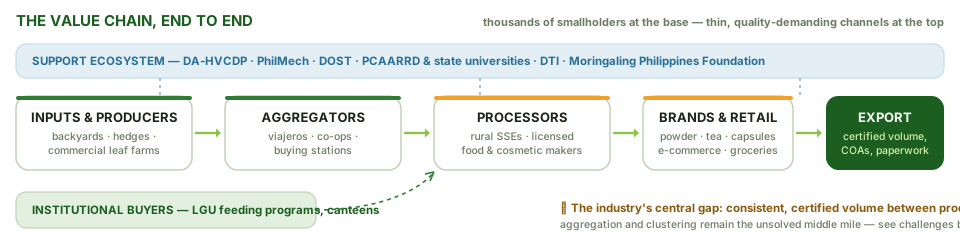
| Stage | Who is there | Where the value sits | What it takes to compete |
|---|---|---|---|
| 1 · Inputs | Seed and seedling suppliers, DA and SUC nurseries, equipment dealers and fabricators | Small margins, steady demand, very little differentiation | Reliability and honest labelling. See seeds and nursery. |
| 2 · Production | Households, fence rows, commercial leaf blocks, pod orchards | The thinnest margin in the chain, especially on fresh leaf sold at farmgate | Yield per hectare, cost per kilo harvested, and a cut cycle that fits the weather. See cost and return. |
| 3 · Aggregation | Market agents, cooperative consolidators, buying stations | Real but hard-won: a trading margin on volume, with quality risk and working capital | The unsolved middle mile, and the subject of section 8. |
| 4 · Processing | Rural drying and milling enterprises, licensed manufacturers | The first big value jump: the same leaf becomes a shelf-stable product worth many times more per kilo. See the product ladder. | Drying discipline, moisture control, licensing, and the capital to bridge a harvest. |
| 5 · Branding & retail | Powder, tea, capsule and cosmetic brands | The widest margins and the highest marketing cost — the stage where most of the final retail price is captured | A brand, packaging, regulatory compliance and shelf access. See ingredient vs brand. |
| 6 · Institutional | Feeding programmes, school canteens, bakeries, feed millers | Thin margins, large volume, contract-based and slow to enter | Specification compliance, documentation and dependable delivery. See institutional channels. |
| 7 · Export | Exporters, consolidators, ingredient buyers abroad | Attractive prices, punishing requirements | Certification, per-lot testing and documentation. See the export playbook. |
3. Value-chain actors
Where the power sits is worth stating plainly, because it decides who sets the price:
| Buyer type | What they demand | Who holds the leverage |
|---|---|---|
| Fresh-market vendor or trader | Volume, appearance, and a price that moves with the day | The trader, almost always. Fresh leaf is perishable and has few alternative buyers within a short drive — see chain margins. |
| Rural processor | Consistent moisture and clean leaf, on a predictable day | Shared: the processor needs supply, the grower needs a dryer, and whoever has the working capital tends to set terms. |
| Licensed manufacturer or brand | Specification adherence, documentation, traceability, repeatability | The buyer, until you are one of the few suppliers who reliably meets the specification — at which point it shifts. |
| Exporter or foreign ingredient buyer | Certification, per-lot laboratory data, volume reliability, documentation | The buyer entirely, until an organised group can supply a container on schedule — which is why aggregation matters commercially. |
4. Where production happens
| Region | Role in the industry | Practical character |
|---|---|---|
| Ilocos Region (I) | Traditional heartland — marunggay country — with active clusters and processing enterprises | A pronounced dry season suits leaf production and field drying; irrigation is the limiting factor in the hot months. |
| Cagayan Valley (II) | Larger commercial blocks and dry-season supply | Bigger landholdings than most of the country; typhoon exposure in the north and east. |
| Central Luzon (III) | Proximity to the Metro Manila market; peri-urban leaf farms | Distance to market is the advantage; land costs and competing crops are the constraint. |
| CALABARZON (IV-A) | Mixed small farms with a brand and processor presence | Urban demand close by, and some of the highest land values in the country. |
| Bicol and Eastern Visayas | Backyard and hedge production with growing commercial interest | Typhoon belt. Wind design and drainage are not optional — see design for wind. |
| Western and Central Visayas | Domestic and market supply, mostly informal | Fragmented island logistics raise the cost of serving institutional buyers. |
| Mindanao (Davao, Soccsksargen, Northern Mindanao) | Year-round growing, exporter interest, contract-growing arrangements | Less typhoon exposure in the south; long transport distances to Manila markets and ports. |
5. Government programs and legal framework
| Instrument or programme | What it actually provides | Who to ask |
|---|---|---|
| High-Value Crops Development Program (DA-HVCDP) | The main channel through which moringa is supported: planting material, production assistance, postharvest facilities and market linkage | Municipal or city agriculture office first, then the DA regional office |
| Republic Act 7904 High-Value Crops Development Act of 1995 | The statutory basis for supporting non-traditional high-value crops — the policy frame under which moringa support flows | Context, not an application. Useful when writing a proposal that cites policy. |
| Republic Act 10068 Organic Agriculture Act of 2010, as amended | Establishes the national organic programme and recognises participatory guarantee systems — the route to a legal organic claim | Organic certification bodies, the NOAB and your regional organic agriculture focal person. See organic certification. |
| Republic Act 10817 Philippine Halal Export Development and Promotion Act | Support structures for halal certification and halal export markets | PAB-accredited halal certification bodies. See halal. |
| PhilMech and DOST | Agricultural machinery design, testing and technology transfer — dryers, mills and processing equipment, often reaching groups rather than individuals | PhilMech, DOST regional offices, and cooperatives that have received equipment |
| PCAARRD and state universities | Variety evaluation, agronomy and postharvest research, product development, industry studies | The SUC nearest you, and PCAARRD for published outputs |
| DTI programmes and trade events | Enterprise development support, OTOP placements and trade fairs that put small processors in front of buyers | DTI provincial office |
| Agricultural credit programmes | Lending under the agri-agra framework and cooperative lending windows | Your bank or cooperative — see funding sources |
Your Municipal Agriculture Office is the doorway to DA programmes, the farmer registry, training and planting-material support — and its staff know which programmes are actually running this year. Start there rather than agency-hunting online. Registered groups also get access to programmes an individual cannot apply for; see group finance.
6. The Moringaling Philippines Foundation
The Moringaling Philippines Foundation, Inc. (MPFI) is the industry's homegrown private organisation — a network of growers, processors and advocates that has promoted malunggay as a nutrition-security and livelihood crop since the mid-2000s. Its contributions have been:
- Popularising the "one hectare is enough to start" framing used in much DA-linked promotion of the crop.
- Organising national moringa congresses and linkages between farmers, buyers and researchers.
- Advocating for moringa's inclusion in government nutrition and livelihood programmes.
- Maintaining grower networks that buyers looking for certified volumes can approach.
MPFI is a private foundation, not a government agency. Membership terms, current programmes and contact details change, and any organisation's claims about buyer linkages should be tested the same way you would test a buyer's: ask who exactly is buying, at what specification, and when. Contact them directly for current activities rather than relying on a description written elsewhere — including this one.
7. Challenges holding the industry back
📉 No production statistics
Backyard dominance means neither DA nor the PSA can quantify supply. Planning, credit and investment all suffer from the data vacuum — and every market-size claim you read should be treated as an estimate.
🧩 Fragmented supply
Buyers need container-loads of consistent powder; individual growers harvest kilos. Aggregation remains the unsolved middle mile — see section 8.
🎨 Quality variance
Sun-bleached, under-dried, stem-heavy powder floods informal channels, dragging prices and the crop's reputation down for careful producers. The processing chapter's quality section is the technical answer.
📜 Certification costs
Organic and food-safety compliance is heavy for small enterprises, and certification support rarely reaches the smallest players. Group certification is the usual workaround — see aggregation.
🌪️ Climate exposure
Typhoons and dry spells swing fresh-leaf supply, and unirrigated farms lose dry-season output precisely when prices rise. See climate resilience and irrigation.
🧠 Research and extension gap
Few locally bred varieties, limited Philippine yield trials, and thinner extension materials than in the countries that invested heavily in moringa science. The evidence chapter shows what that means for claims.
Read together, these are not six unrelated problems. Five of them are symptoms of one: a crop that is grown informally is supplied informally, and informal supply cannot serve formal buyers. That single diagnosis is why the next section is the most important one in this chapter.
8. The middle mile: aggregation
The gap between what a smallholder harvests and what a processor can buy is the industry's central structural problem, and it is a business opportunity rather than a reason to give up.
The arithmetic is unforgiving and worth stating plainly. A licensed processor buying for a powdered-food contract wants delivery in tonnes, to a specification, on an agreed date, with documentation. A grower with half a hectare produces a few hundred kilos a cut, on a date decided by the weather, to no formal specification at all. Neither party is being unreasonable; they are simply not addressable to each other without something in between.
| What the middle needs | Why it is hard | Where this site deals with it |
|---|---|---|
| Volume from many small lots | Collection points, weighing, receipts and reconciliation — real administration, usually unpaid at first | Pooling mechanics |
| One specification across all the lots | Members must accept a rule they did not write, and it must be enforced against a neighbour | The quality charter |
| Working capital to pay before the buyer pays | The classic trap: the aggregator funds the gap between harvest and settlement | Cash flow |
| Shared processing capacity | A dryer or mill is unaffordable alone and socially difficult to share | Buy, rent or share, and shared infrastructure |
| Records that a buyer will accept | Documentation has to be created at intake, not reconstructed before an audit | The eight records |
9. The export opportunity
The global moringa market — supplements, food ingredients and cosmetics inputs — has grown steadily since the 2010s, with North America, Europe and parts of Asia and the Middle East as the significant destinations. The Philippines' natural advantages are real: English-speaking suppliers, an established food-manufacturing sector, and a credible tropical-superfood story. The bar is also real, and it is documentation rather than agronomy.
Certification
Organic to the destination's standard (or at minimum GAP plus food-safety systems such as GMP and HACCP); halal where the market requires it. Buyers audit or demand certificates.
Laboratory-backed specifications
Certificates of analysis for moisture, microbiology, heavy metals, aflatoxin and pesticide residues, from accredited laboratories, per lot — not once a year.
Volume reliability
Exporters aggregate from clusters and groups. A single farm plugs into that system; it rarely replaces it. This is section 8 applied to a container.
Documentation
Phytosanitary certification, certificate of origin, the relevant FDA registrations, and whatever the destination market requires on its own side. See the documentation set.
| Channel | Who buys | The realistic entry point | The main barrier |
|---|---|---|---|
| Specialty and ethnic grocery abroad | Distributors serving Filipino, South Asian and health-food communities | Retail-ready branded packs, or private-label supply to a distributor | Packaging, labelling to that market's rules, and freight economics on small volumes |
| Ingredient and bulk buyers | Food manufacturers, supplement makers, blenders | Bulk powder or tea-cut leaf against a written specification, with a certificate of analysis per lot | Consistency at volume and heavy-metal and microbiological limits |
| Halal and Middle East markets | Importers and distributors serving halal supply chains | Halal-certified product through an accredited certifier | Certification cost and a validated halal supply chain |
| Cosmetics and personal care | Formulators buying oil or powder as an ingredient | Ben oil or cosmetic-grade powder with the relevant documentation | Oil quality parameters, particularly oxidation values, and seed supply limits |
10. Outlook
The structural pieces are in place: genuine cultural demand, institutional support, a private-sector champion, and growing global interest in the crop. What remains scarce is exactly what new entrants can supply — organised, documented, quality-consistent volume, whether that means a well-run block with a contract, a shared dryer in a functioning cluster, or an aggregation business that connects the two.
Two cautions belong in an honest outlook. First, the fresh market is and will remain the largest domestic use of the crop, so the least glamorous channel is also the most reliable. Second, the products with the largest margins — capsules, cosmetics, exports — carry the heaviest compliance and the longest cash cycle, which is why this site keeps repeating that processing and documentation, not enthusiasm, are what move a moringa enterprise up the chain.
11. How to check any claim in this chapter
The moringa sector is unusually prone to confident numbers with no source behind them. These are the places to check, and the questions that separate a fact from a repetition.
| Claim type | Where to verify it | The question to ask |
|---|---|---|
| Production or market size | Philippine Statistics Authority (PSA) countrystat data; DA regional reports; peer-reviewed industry reviews | Does this figure include backyard and subsistence production, or only formal channels? If the source does not say, assume it excludes them. |
| A law or regulation | The Official Gazette, the FDA Philippines, the BAFS, the CDA, the BPI | What is the exact instrument number and title? If a claim cannot name one, it cannot be relied on. |
| A programme or grant | Your municipal agriculture office; the DA regional office; the agency named | Is it running this year, who is eligible, and what are the counterpart requirements? |
| A price or yield | Your own records; the DA's price monitoring; local traders and processors; a state university's trials | Is this a farmgate or retail price, a fresh or dry basis, and from when? Prices on this site are ranges for that reason. |
| A health or nutrition claim | The evidence chapter; published human trials; the FDA's labelling rules | Is the finding from humans, animals or a laboratory dish — and at what dose? See how to read a study. |
| A buyer's requirement | The buyer, in writing | Which specification, which test, at whose laboratory, and by when? |
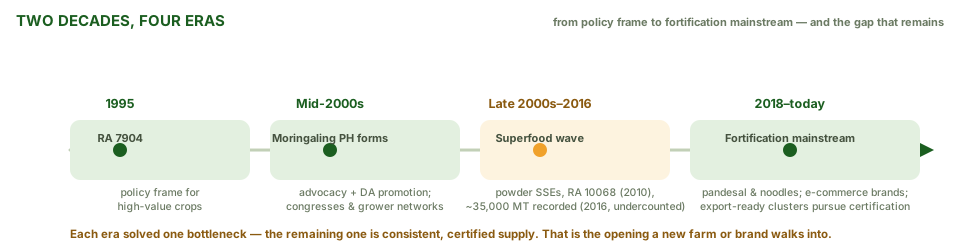
12. Industry milestones timeline
Two decades of institutional history explain where the industry stands today — and which gaps remain open for new entrants.
Questions people actually ask: FAQ & Help. Compute your own farm plan: Density & Income Calculator. Sell together instead of alone: Cooperatives & Aggregation. Glossary, sources and the editorial disclaimer: Resources.