 Malunggay Compass
1. Industry snapshot
No one knows exactly how much malunggay the Philippines produces — a symptom of how the crop is grown. Most production comes from unrecorded backyard and hedge plantings, so official statistics understate reality while commercial blocks remain a small fraction of the crop's true footprint.
- Structure: thousands of smallholders and household plantings; a modest number of commercial leaf farms (roughly 1–5 ha typical); a few dozen processors/brands; and a thin exporter layer.
- Documented commercial production is concentrated in Ilocos Region, Cagayan Valley, Central Luzon, CALABARZON, and parts of Mindanao (Davao, Soccsksargen).
- Recorded yields cited for the country (e.g., ~35,000 metric tons in 2016 in industry reporting) capture only formal channels — the palengke trade alone is vastly bigger.
- Demand drivers: the fortification trend (moringa pan de sal, noodles, “malunggay pandesal” programs), herbal supplement popularity, cosmetics, and institutional feeding programs.
- Persistent gap: demand for consistent, certified raw material exceeds supply — buyers report difficulty sourcing stable volumes of quality leaves and powder.
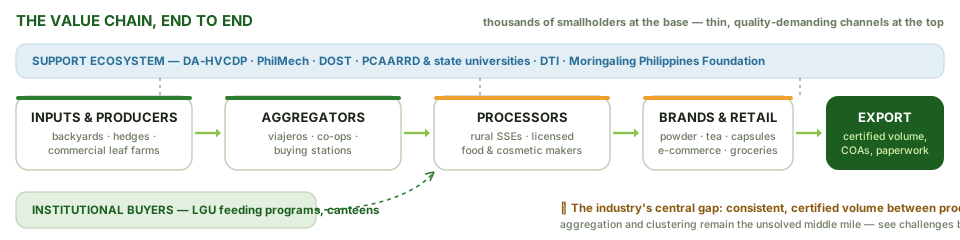
2. Value-chain actors
3. Where production happens
| Region | Role in the industry |
|---|---|
| Ilocos Region (I) | Traditional heartland (marunggay country); dry climate suits leaf production; active clusters and processing SSEs |
| Cagayan Valley (II) | Large commercial blocks; dry-season supply backbone |
| Central Luzon (III) | Proximity to Metro Manila markets; peri-urban leaf farms |
| CALABARZON (IV-A) | Mix of small farms and brand/processor presence |
| Bicol & Eastern Visayas | Backyard and hedge production; emerging commercial interest |
| Mindanao (Davao, Soccsksargen, Northern Mindanao) | Year-round growing conditions; exporter interest; contract-growing schemes |
4. Government programs and legal framework
- High-Value Crops Development Program (DA-HVCDP): the main DA program under which moringa is promoted — planting materials, production support, postharvest equipment, and market linkage for high-value crops including malunggay.
- Republic Act 7904 (High-Value Crops Development Act of 1995): the statutory basis for HVCDP; directs support for non-traditional high-value crops.
- Executive Order 993? — No: the often-cited moringa push is better anchored in DA administrative promotion and HVCDP planning than a single EO; be wary of uncited “moringa law” claims online. (The genuinely relevant instruments are RA 7904 and RA 10068, below.)
- Republic Act 10068 (Organic Agriculture Act of 2010, as amended by RA 11511): establishes the National Organic Agriculture Program, NOAP budget, PGS recognition — the route to legal “organic moringa” claims.
- PhilMech & DOST programs: mechanical dryers, milling equipment, and processing commons for farmer cooperatives.
- PCAARRD/SUC R&D: variety evaluation, agronomy trials, product development, and industry studies (the 2015 Acta Horticulturae industry review by Philippine researchers is the standard citation).
- DTI trade events: OTOP (One Town One Product) placements and trade fairs frequently feature moringa SSE products.
Your Municipal Agriculture Office (MAO) is the doorway to DA programs, farmer registry, training, and planting material support. Start there before any agency-hunting online.
5. The Moringaling Philippines Foundation
The Moringaling Philippines Foundation, Inc. (MPFI) is the industry's homegrown private organization — a network of growers, processors, and advocates that has campaigned for malunggay since the mid-2000s. Its contributions:
- Popularized the “1 hectare is enough to start a profitable moringa farm” framing used in DA-linked promotion.
- Organized national moringa congresses and linkages between farmers, buyers, and researchers.
- Promoted moringa as nutrition-security crop and lobbied for its inclusion in government programs.
- Maintains grower networks used by buyers seeking certified volumes.
MPFI is a private foundation, not a government agency — its programs and membership details change; contact them directly for current activities.
6. Challenges holding the industry back
📉 No production statistics
Backyard dominance means nobody — not DA, not PSA — can quantify supply. Planning, credit, and investment all suffer from the data vacuum.
🧩 Fragmented supply
Buyers need container-loads of consistent powder; farmers harvest kilos. Aggregation and clustering remain the unsolved middle mile.
🎨 Quality variance
Sun-bleached, under-dried, stem-heavy powder floods informal channels, dragging prices and reputation down for careful producers.
📜 Certification costs
Organic and food-safety compliance costs are heavy for small SSEs; certification support rarely reaches the smallest players.
🌪️ Climate exposure
Typhoons and dry spells swing fresh-leaf supply, and unirrigated farms lose dry-season output exactly when prices rise.
🧠 R&D gap
Few PH-bred varieties, limited local yield trials, and thin extension materials compared with India's investment in moringa science.
7. The export opportunity
The global moringa market — supplements, powders, cosmetics inputs — has grown steadily since the 2010s, with the US and EU as anchor markets. The Philippines' advantages: English-speaking suppliers, established food manufacturing, and a “Philippine superfood” story. The bar:
Certification
Organic (USDA/EU or JAS) or at minimum GAP plus food-safety (HACCP/GMP); buyers audit or demand certificates.
Lab-backed specs
COAs for moisture, microbiology, heavy metals, aflatoxin — from accredited labs, per lot.
Volume reliability
Exporters aggregate from clusters; a single farm plugs into that system rather than replacing it.
Export documentation
BPI phytosanitary certificate, FDA-related registrations, certificate of origin, and destination-country facility registrations.
8. Outlook
The structural pieces are in place — cultural demand, institutional support, a private-sector champion foundation, and global market growth. What remains scarce is exactly what a new entrant can provide: organized, documented, quality-consistent supply. For a well-run hectare with a buyer in hand, malunggay remains one of the most accessible high-value crop entries in Philippine agriculture.
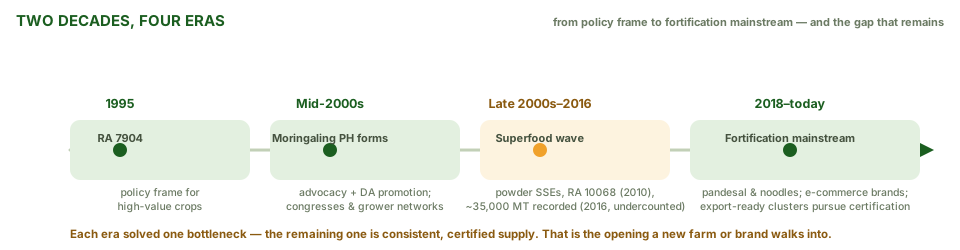
Industry milestones timeline
Two decades of institutional history explain where the industry stands today — and which gaps remain open for new entrants.
Questions people actually ask: FAQ & Help. Compute your own farm plan: Density & Income Calculator. Glossary and full references: Resources.