 Malunggay Compass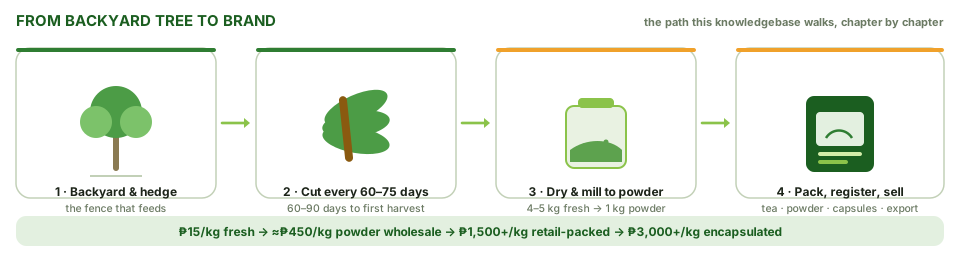
Chapters in this knowledgebase
Each chapter stands alone, but the sequence below is the intended path from “what is malunggay?” to “how do I build a moringa business in the Philippines?”
Overview & Botany
What moringa is, where it came from, how it grows, and why it thrives in Philippine backyards. Plant morphology from roots to pods, local names across regions.
CHAPTER 02Varieties & Selection
The nine-plus species of Moringa, plus cultivated types — PKM-1, PKM-2, Philippine “native” — and how to choose planting material for leaves, pods, or oil.
CHAPTER 03Cultivation Guide
The complete Philippine grower's manual: climate and soil fit, propagation, spacing, fertilization, pruning, IPM for local pests, and harvest schedules for leaf and pod production.
CHAPTER 04Climate Resilience
Typhoon, drought, flood and heat survival: exposure mapping, wind-friendly design, seed versus cuttings for anchorage, the post-storm protocol, and PCIC crop insurance.
CHAPTER 05Nutrition & Health
What the science says about malunggay's nutrients and bioactives — and what it does not say. Includes safety notes, dosage context, and classic Filipino dishes.
CHAPTER 06Economics & Business
Farmgate prices, sample cost-and-return budgets for ½- to 5-ha farms, market channels, and the honest math on fresh leaves vs. powder vs. seed oil.
CHAPTER 07Operations, Contracts & Scale
Running the business: a labour calendar in man-days per hectare, the seedling nursery as a first enterprise, a buyer toolkit with specification and agreement templates, and three farm profiles.
CHAPTER 08Processing & Products
Postharvest handling, low-temperature drying, powder milling, ben oil extraction, seedcake water treatment, and the FDA Philippines paperwork behind every packaged product.
CHAPTER 09Compliance & Certification
The paperwork path to selling above the wet market: FDA licence to operate and product registration, GMP and HACCP, organic and halal certification, per-lot lab testing, and lot traceability.
CHAPTER 10Livestock & Aquaculture Feed
Leaf meal as a feed ingredient: why fibre caps inclusion, reported rates for pigs, poultry, ruminants and tilapia, seed cake as a co-product, and how to price protein.
CHAPTER 11Industry & Policy
The state of the Philippine moringa industry — actors, government programs, the Moringaling Philippines Foundation, laws and regulations, and the export opportunity.
TOOL 12Density & Income Calculator
Interactive planning tool: presets for hedge, intensive, orchard, and fence systems compute plants per hectare, cuts per year, yields, revenue, margin, and break-even prices as you type.
CHAPTER 13Malunggay Kitchen — Recipes
Fourteen Filipino dishes from tinola to malunggay pandesal, with prep fundamentals, fresh-to-powder conversions, and institutional-scale cooking guidance.
CHAPTER 14FAQ & Help
27 practical questions from aspiring and active growers, answered concisely: germination, spacing, income, buyers, organic certification, and more.
CHAPTER 15Resources & References
Glossary of moringa terms, downloadable-ready references, and links to DA, PhilMech, PCAARRD, and the research literature behind this knowledgebase.
APPENDIXSite Map
Every page on this site in one place — useful for readers, crawlers, and anyone who arrived here from a deep link.
Five reasons the Philippines should farm more of it
It is already a staple vegetable
Malunggay is in tinola, bulanglang, sinigang, and law-uy dishes nationwide. Demand for fresh leaves exists every day of the year, in every public market.
Nutritionally dense, scientifically studied
Leaves deliver protein, iron, calcium, and vitamins A and C in meaningful quantities. Hundreds of peer-reviewed studies examine its bioactives and health effects.
Drought-hardy and low-input
Once established, moringa tolerates dry seasons that wilt other vegetables — a hedge for farmers in Regions with long dry spells and thin irrigation.
Processing multiplies value
Dried leaf powder, tea, oil, soap, and capsules can command multiples of fresh-leaf prices, opening formal retail, cosmetic, and export channels.
An organized industry push
The Moringaling Philippines Foundation, DA programs, and state universities have spent two decades organizing growers, standards, and market linkage.
Fast returns on small land
Leaf harvests can begin 60–90 days from planting; a one-hectare block is enough to start a viable operation with modest capital.
Where moringa fits in Philippine agriculture
Malunggay grows in every Philippine province, yet it has rarely been counted a serious commercial crop. Most trees are fence-line or backyard plantings; commercial blocks concentrate in Ilocos Region, Cagayan Valley, Central Luzon, and parts of Mindanao.
Since the early 2000s, government agencies and industry groups have pushed to change that: promoting moringa as a high-value crop, supporting powder processing enterprises, and organizing growers into associations capable of supplying institutional buyers and exporters.
This knowledgebase consolidates that institutional knowledge — plus the underlying research — into one place, written for Filipino growers, students, and agripreneurs.
Read the industry chapterFigures are indicative ranges drawn from the research literature and DA-cited industry sources; local results vary with variety, density, and management. See Resources for sources.