 Malunggay Compass
The genus Moringa
Moringaceae contains roughly 13 accepted species, from annual herbs to bottle trees. Only M. oleifera matters commercially in the Philippines, but the others are worth knowing — especially because a few niche markets pay premiums for them.
| Species | Common name | Form & origin | Notes for growers |
|---|---|---|---|
| M. oleifera | Malunggay; drumstick tree | Fast tree, NW India; pantropical | The commercial crop worldwide — leaves, pods, seeds, oil. All main content of this site refers to this species. |
| M. stenopetala | African cabbage tree | Tree, Ethiopia/Kenya | Larger leaflets, more drought-hardy; staple vegetable in southern Ethiopia. Rare in the Philippines; niche interest. |
| M. drouhardii | Bottle tree | Swollen-trunk tree, Madagascar | Ornamental/curiosity; not a leaf crop. |
| M. hildebrandtii | — | Bottle tree, Madagascar | Ornamental; drought landscaping. |
| M. peregrina | Wild drumstick tree | Shrub/small tree, Arabia/Red Sea | Oil-rich seeds; wild-harvested where native. Experimental elsewhere. |
| M. concanensis | — | Tree, peninsular India | Intergrades with M. oleifera; of interest to breeders for drought traits. |
| Other species | M. rivae, M. borziana, M. longituba, M. ruspoliana, M. arborea, M. ovalifolia, M. apperi | Africa, Arabia, Madagascar | Largely wild, threatened, or locally used; not commercial crops. |
Philippine planting material: “native” and improved local strains
Most malunggay in the Philippines is unselected material — seedling trees grown from seed collected from backyard trees and hedges. This “native” population is genetically diverse: some trees are outstanding, others mediocre. Its advantages and drawbacks:
- Advantages: well adapted to local conditions, familiar taste to local buyers, seed is nearly free, and decades of backyard selection have quietly favored productive, palatable trees.
- Drawbacks: uneven vigor, variable leaf flavor and color, no documented yield guarantees — a real issue when buyers demand consistent raw material for powder.
In response, Philippine institutions have evaluated selections and imported Indian material. Some growers now maintain mother-tree blocks — orchards of deliberately selected high-yielding native trees used for seed and cutting production.
If you are planting for the fresh vegetable market, well-selected local material is usually enough. If you are planting for powder, capsules, or export, consistency becomes a specification — use a registered variety or a documented mother-tree line, and keep records of your source.
Indian cultivars: PKM-1 and PKM-2
India runs the world's most advanced moringa breeding program at the Periyakulam Horticultural College (Tamil Nadu Agricultural University). Its two flagship annual-type pod varieties have been trialed in the Philippines and are widely referenced:
PKM-1
Type: seed-propagated, annual-style pod variety.
- Early: first pods around 6–8 months
- High pod yield potential (reported up to ~50+ t/ha under intensive management in India)
- Prolific branching, manageable height
- Suitable for dense planting and annual crop cycles
In the Philippines, mostly grown by a few commercial farms and home gardeners; seed must be re-purchased or produced on-farm under isolation.
PKM-2
Type: hybrid, annual-style pod variety.
- Longer pods (~90–100+ cm), heavier individual pods
- Very high yield potential under Indian conditions
- Seed cost higher; F2 progeny segregate, so hybrid seed should be bought fresh
- Best for specialist pod producers targeting Asian vegetable trade
Pod length and weight impress, but the Philippine fresh market's familiarity with native drumsticks means marketing matters more than genetics here.
Other Indian accessions referenced in literature include MO-1, MO-2, MO-3, Coimbatore-1/2, and regional types such as Jaffna (Sri Lanka) and Chavakachcheri. For leaf-production systems, breeders note that dense annual plantings of vigorous material outperform “variety” labels: management (spacing, cutting height, fertilization) drives leaf yield more than the cultivar name.
Importing seed into the Philippines requires a permit from the Bureau of Plant Industry (BPI). Buying unverified “PKM” seed from informal online sellers risks poor germination, mislabeling, or quarantine problems. Source through legitimate suppliers or institutional partners, and keep documents.
Choosing by production goal
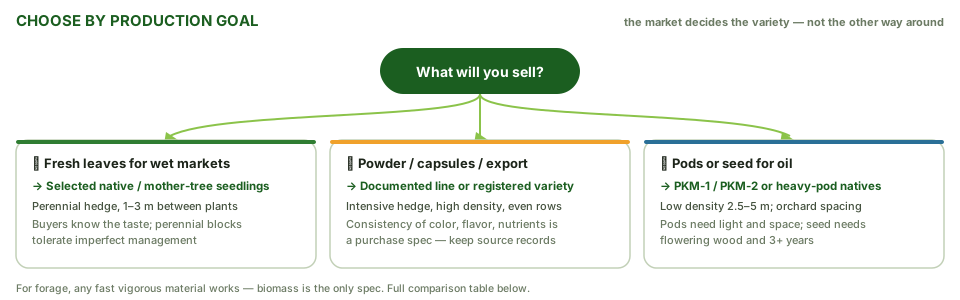
| If your goal is… | Best material choice | System | Why |
|---|---|---|---|
| Fresh leaves for wet markets | Selected native trees / mother-tree seedlings | Perennial hedge, 1–3 m between plants | Buyers know the taste; perennial blocks tolerate imperfect management |
| Dried powder / capsules | Documented line or registered variety, single source | Intensive perennial hedge, high density, mechanizable rows | Consistency of color, flavor, and nutrient profile is a purchase spec |
| Vegetable pods (drumsticks) | PKM-1/PKM-2 or heavy-pod native selections | Low density (2.5–3 m), annual or biennial cycle | Pods need light and space; annual systems maximize pod numbers |
| Seed for oil / re-sale | Mature, well-spaced trees of any vigorous line | Orchard spacing, 3+ years stand | Seed yield needs flowering wood and time |
| Forage / livestock feed | Any fast-growing vigorous material | Very dense (up to 1M+ plants/ha), cut every 35–45 days | Biomass is the only spec that matters |
Seed vs. cuttings
Seed propagation
- Pros: cheap, produces a strong taproot (better drought anchorage), plants live longer, ideal for large plantings
- Cons: variability between plants (if material is unselected), slightly slower to first harvest than big cuttings
- Technique: sow fresh seed 1–2 cm deep in trays or bags; germination in 5–12 days at warm temperatures; transplant 4–6 weeks later
Cutting propagation
- Pros: clones a known-good mother tree; very fast early growth; traditional for backyard plantings
- Cons: shallow, “broomy” root system (poorer drought anchorage and storm resistance); mature wood cuttings can carry pests
- Technique: hardwood cuttings 1–1.5 m long, 4–10 cm thick, planted ⅓ deep during the rainy season; root in 2–6 weeks
Seed for plantations, cuttings for backyards. Commercial leaf blocks planted from seed (or tissue-cultured/selected seedlings) stand up to typhoons and dry spells better than cutting-raised blocks, whose shallow roots can lift and topple in saturated soil.
On-farm selection and improvement — a practical protocol
Because most Philippine material is unselected, an observant farmer can build a measurably better line in three years with nothing but rigor and record-keeping — no lab, no imported seed.
Year 1 — plant wide, watch closely
Establish 300–500+ seedlings of diverse local origin in a provisioning orchard (2–3 m spacing). Tag every plant with number, source, and date. This is your selection population.
Score ruthlessly
Every cut cycle, rate each tree on a 1–5 scale: flush density, leaflet size and color, regrowth speed after cutting, tenderness of stems, pest pressure, and (for pod lines) flowering and pod set. One notebook column per trait keeps it honest.
Rogue the laggards
After 3–4 scored cycles, remove the bottom ~30% of trees. Their space lights up the top performers — the classic mass-selection gain.
Clone the champions
Propagate the top 5–10% by cuttings into a separate mother block. (Remember cuttings' shallow-root caveat — keep the mother block staked and mulched; use their seed, not their cuttings, for plantation blocks.)
Year 3+ — control the pollen
Seed from open-pollinated mother blocks is already a step up; for stronger gains, hand-pollinate between your two best trees and bag flowers to produce controlled-cross seed. Label lots separately and keep scoring the offspring.
Repeat — selection never ends
Every generation, keep the discipline: score, keep the best, cull the rest. Farms that do this quietly out-yield neighbors planting unselected seed within a few years.
Selection reliably improves regrowth rate, flush density, leaf color, and pest tolerance — the traits that drive leaf income. It moves slowly on pod length and oil content, where imported genetics (PKM lines) may still win. See the density & income calculator to quantify what a yield gain is worth per hectare.
Sourcing and quality checks
Define your market first
Fresh leaves, powder, pods, or seed? The market determines the variety decision — not the other way around. Revisit Economics & Business before buying anything.
Buy from documented sources
Prefer DA-accredited nurseries, university nurseries (e.g., state universities with moringa RDE programs), or the Moringaling Philippines Foundation network. Ask for source records and mother-tree information.
Test germination before committing
From any seed lot, sow a 50–100 seed sample on damp paper or in a seedbox. Good fresh moringa seed germinates above 80% within 10–14 days. Below 60%, renegotiate or reject.
Inspect seedlings like a buyer
Uniform height, healthy green leaves, no yellowing, no stem lesions, white roots not circling the bag. Reject seedlings taller than ~45 cm in small bags — they are root-bound and will check badly.
Keep records from day one
Log supplier, lot, date, and field position. Certification schemes (organic, GAP) and buyers of processed powder will ask for traceability later.
Buying planting material: myths and mistakes
The moringa boom has created a market for planting material — and, with it, a fog of half-truths. None of these errors will kill a farm by themselves, but each one quietly degrades the block you will harvest for years. The honest corrections:
🏷️ “Guaranteed PKM-1” at premium prices
PKM-1/PKM-2 are pod-type selections from Periyakulam, India, and most “PKM” seed sold locally is unverified. Unless the seller documents origin, treat it as ordinary seed and pay ordinary prices. Its value matters mainly for pod orchards — not leaf blocks.
🌳 “Cuttings are always true-to-type”
Cutting propagation clones the mother tree — but only if the mother was actually selected. A cutting from the neighbor's unimproved hedge clones mediocrity with perfect fidelity. Clone deliberately: pick documented, high-yielding, disease-free mother trees.
⏳ “Older, bigger seedlings are better buys”
Seedlings past ~45 cm in small bags are root-bound; they stall in the field while younger, compact seedlings overtake them. Buy youth and health, not size — uniform 25–35 cm stock in fresh medium out-performs tall, pot-stressed plants.
🧬 “One tree, big harvest — plant it everywhere”
An outstanding single tree may owe its performance to its spot — deeper soil, better drainage, an unshaded corner. Confirm over a full year and across several trees of the same line before scaling it up through seed or cuttings.
🌱 “Seed is seed — age doesn't matter”
Moringa seed loses vigor within a year at room conditions; old lots germinate unevenly, and weak, straggly starts rarely recover the gap. Ask when the seed was harvested, store it airtight and cool, and test-germinate before sowing a field (checks above).
🚫 “Improved material needs no management”
No variety overcomes crowded spacing, exhausted soil, or neglect after cutting. Genetic potential is a ceiling, not a substitute for the fertilizer and pruning discipline in the Cultivation Guide.
Pay for documentation, not labels: a recorded mother tree and a recent germination test are worth more than any name printed on a seed packet.
With planting material chosen, move to the Cultivation Guide — climate, spacing, nutrition, pruning, and harvest. For what these varieties contain, see Nutrition & Health.